Hughes arrived at Keeneland on October 30 with four wins from four starts, and left it as the early name to beat for next year’s Kentucky Derby. Baffert trains him, Flavien Prat had the mount, and the crowd sent him off at even money. He stayed in front, finished 2¼ lengths clear of runner-up American History and stopped the clock at 1:42.27 for 1 1/16 miles. Five from five now. Three of those first four wins were by six lengths or more.
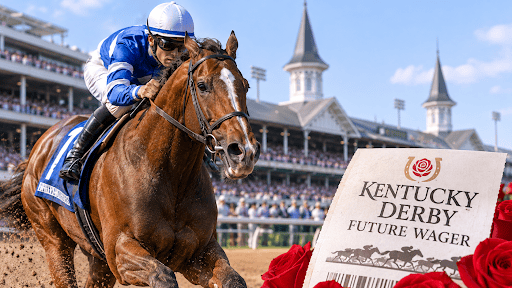
The Derby is May 1, 2027, so nobody cashes a ticket next week. A bet this far out needs a different tool, and Churchill Downs runs one: futures pools called the Future Wager.
A pool pays by its final odds, so the price is set when betting closes, not when you buy in. A sportsbook posts a fixed price and locks it in for you. If you want to see both sides, check crypto bookmakers against the pool odds before the next window opens, then decide where the number looks better.
How the pools work
Pools have offered $2 win and exacta bets. You can pick a named horse or take “All Others,” a catch-all for every horse not listed on its own. That option is often the favorite. It closed at even money in Pool 1 this fall.
Prices are longer than on Derby day because nobody knows yet which horses will make the field. The catch is simple. Once you’ve bought in, the money stays in. A horse that gets injured, gets scratched or just misses the cut takes your stake with it.
Two examples from the last cycle show how wide the outcomes are. Sovereignty closed at 19-1 in Pool 2 and 21-1 in Pool 3, then won the 2025 Derby. Then there is Ted Noffey, who took the 2025 Juvenile. When Pool 2 shut that November he was the top named horse, a seven-to-one shot. Bone bruising pulled him off the Derby trail by late January.
The 2026-27 calendar
Pool 1 is already done. Four more run through mid-March, and the last one opens in April. Betting opens at midday Eastern on day one and shuts at 6 p.m. Eastern on the final day.
- November 26–29: Pool 2, with a side pool on sires
- January 15–17: Pool 3
- February 12–14: Pool 4
- March 12–14: Pool 5, with a Kentucky Oaks pool added
- April 1–3: Pool 6, and the Oaks pool again
Pool 2 is the first look at how the market prices Hughes after the Juvenile. Pool 1 closed before the race.
What Hughes’ win changes
For years the “Juvenile jinx” was treated as fact: win the Juvenile, forget the Derby. The record is thinner than the legend. Only six horses that ran in the Juvenile have gone on to win the Derby, and three of them did it this century. Street Sense in 2007, Mine That Bird in 2009 and Nyquist in 2016. So the double is rare, but it isn’t a curse.
Points matter more than reputation. The Derby field is capped at 20 and filled by points. The Juvenile pays its winner 30. Early preps pay 10-5-3-2-1 to the top five, while the big April preps pay 100 to the winner. Thirty points is a head start, not a ticket.
The distance is the other question. The Derby is 1¼ miles, a furlong and a half longer than the Juvenile. A colt who wins by daylight at 1 1/16 miles can still look different at the Derby trip.
What to check before you put money down
- Rival preps: the Kentucky Jockey Club at Churchill Downs on November 28 runs inside the Pool 2 window, and the Remsen at Belmont follows on December 5
- The Remington Springboard Mile on December 19 at Fair Grounds pays its winner 50, far more than the other December preps
- Whether Hughes stretches out in his next start, since the Derby trip is the real test
- The payout against how far away May 1 still is
Treat the pool as a ticket you hold for months. Set the stake you can afford to lose, because the price on Hughes will move with every prep, and so will everyone else’s.