

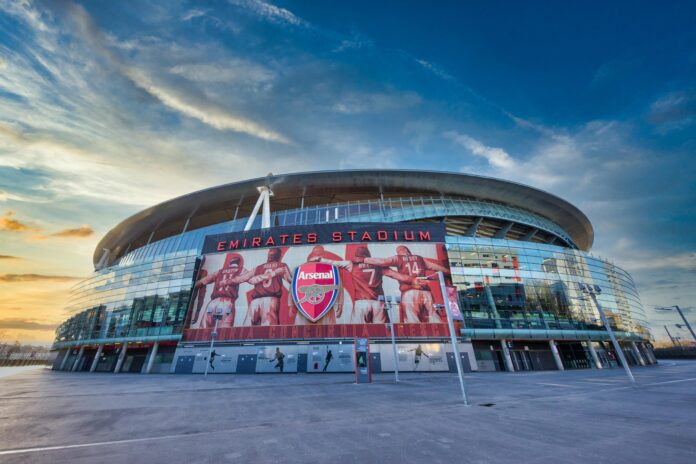
By the time February arrives, the Premier League usually stops being about promise and starts being about preservation. The teams at the top are no longer chasing form. They are trying to protect what they have built while the calendar tightens and every dropped point feels heavier than the last. Arsenal enter this phase six points clear at the summit, and the numbers suggest their position has been earned over months rather than assembled in a rush.
Through 25 matches, Arsenal have taken 56 points, which puts them on 2.24 points per game. Manchester City, with the same number of games played, sit on 50 points at an even 2.00 per game. That separation is significant because it has not been driven by a short burst of results. Arsenal’s return across their last eight league matches tracks closely with their season-long output, which tells you their level has held rather than spiked.
You are not looking at a team riding a moment. You are looking at one sustaining standards under the demands of Mikel Arteta. That does not mean Arsenal are immune to pressure. Professional sport, whether it is football, baseball or golf, has a long history of late-season nerves producing the unexpected. Judged purely on the numbers available in early February, though, Arsenal remain in the strongest position.
Why Arsenal’s Lead Is Built on Stability, Not Momentum
One way to assess whether a lead is fragile is to look for swings. Arsenal’s numbers do not show many. Their 2.13 points-per-game figure over the last eight matches sits only fractionally below their season average, which is what stability looks like at this stage of a season. City’s recent return of 1.63 shows more movement away from their baseline, a reminder that even elite sides do not always move through the calendar without friction.
If you are viewing the title race through a betting or analytical lens, that steadiness carries real significance. Fewer fluctuations reduce uncertainty. It becomes easier to assess outcomes when performance stays within a narrow band and does not rely on sharp peaks to compensate for dips elsewhere.
When a lead is built this steadily, the conversation naturally shifts from whether it will hold to how people follow it over the remaining months.
Following a Title Race That Plays Out Over Months
When a title race stretches across months rather than weeks, the way you follow it changes. Instead of reacting to single fixtures, you start thinking in longer arcs, form cycles, injury windows and margin for error. If you are a soccer fan in Canada tracking Arsenal’s attempt to win their first league title since 2004, that longer view often extends beyond the pitch itself.
This stake bonus code guide provides a clear breakdown of how Stake’s current Canadian offer operates across sportsbook wagers as well as casino games. The page explains practical elements such as wagering requirements that include sports bets, minimum deposit levels, regional availability outside Ontario and the absence of an expiry date on rollover. The detail on wagering terms, eligibility and rollover structure is especially relevant when you are looking at bets that sit over weeks or months rather than a single matchday.
Long-season markets typically reward patience and structure, much like championship challenges themselves.
Away Form and the Quiet Importance of Control
Title races are often decided away from home, where teams must grind out results in hostile environments. Arsenal’s recent away form suggests they are handling those environments well. Over their last four away league matches, they are unbeaten with three wins and a draw, collecting 10 points and recording a goal difference of plus six.
City over the same stretch have taken five points on the road with a negative goal difference. That contrast does not settle anything on its own, but it does point to which side is managing unfamiliar settings more efficiently as pressure increases.
Late goals remain a feature of the league as a whole. Almost 27 percent of Premier League goals this season have arrived after the 75th minute. Arsenal are still susceptible to that volatility, but they often enter those closing phases with a margin. Extending leads lowers the likelihood that late pressure reshapes results rather than simply trimming scorelines.
Depth, Game State and Why Bench Impact Changes Outcomes
Arsenal’s bench contribution has quietly become one of the defining features of their season. They lead the league in goal contributions from substitutes, with several of those directly altering match states through equalisers or winners. These are not cosmetic additions to scorelines. They are points gained or protected.
When you step back, the significance is clear. Arsenal are not dependent on perfect starts or uninterrupted dominance. They can recover within games and close them without retreating into survival mode. Over a long title run, that kind of game-state management reduces risk in ways that are not always obvious in highlights or post-match summaries.
The Run-In and Why Arsenal Still Control Their Own Outcome
Run-in analysis reinforces the same picture. Arsenal’s remaining opponents average 1.19 points per game, a lower level than the teams they have already faced. Put simply, the most demanding portion of their fixture list is largely behind them. Reaching this stage with a strong scoring rate and the league’s tightest defensive record gives that advantage real weight.
City’s remaining schedule does not ease in the same way. Their opponents average closer to 1.33 points per game, which means the difficulty level holds steady. The margin for error does not expand.
This is where psychology enters the equation, but through constraint rather than drama. City’s presence shortens the space for mistakes. Arsenal cannot drift or rely on others slipping. They must continue performing at roughly the same level they have shown all season. The evidence suggests they are equipped to do exactly that.
So is this Arsenal’s title to lose? On the numbers available in February, yes. Not because the race is finished, but because Arsenal have built a position that does not depend on fortune elsewhere. If you are assessing the Premier League through a data-led lens, the structure supporting their lead is already in place.