
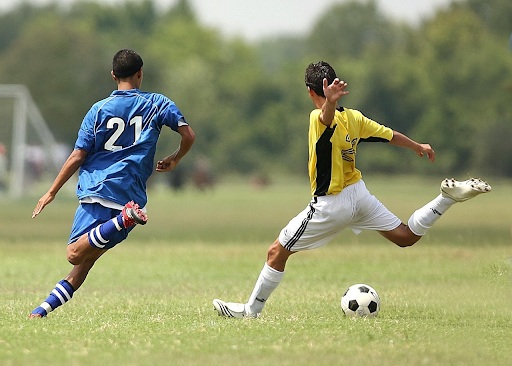
Khadar doesn’t have a contract. No salary, no clubhouse, no goals with proper nets. What he has is a patch of ground in Yaqshid and a group of boys who show up because word got around that he does – reliably, several times a week, season after season. He has never earned anything from it. Asked once why he keeps going, his answer was hard to argue with: he can see what’s happening out there, and that’s enough.
What’s happening is actual football development. Chaotic at the edges, informal in every administrative sense, but real in the ways that matter. Boys learning to read where space will open before it does. Learning to receive under pressure without panicking. Making fast decisions on the move. The kind of instincts that scouts, when they eventually turn up, tend to notice within the first few minutes.
The footballing facilities available in Somalia are somewhat limited, with that energy being utilized by individuals supported by coaches such as Khadar, who have only built because there was nothing more formal available. The fan aspect of the football game appears to be equally ‘organic’. Support for the game by the Somali people is done through any available means, radio for the older generation, and mobile phones for everyone else. Part of this audience participates in online betting, so they bet first on the outcome of the games of East African clubs, and thus follow the competitions with more interest because they have something to bet on. There are multiple platforms such as 1xbet that exist at the intersection of sports and betting. These sites allow Somali fans to track the odds on the football matches being played in their region as well as in the entire continent of Africa, which helps them remain in contact with the sport throughout the week.
What the Spreadsheet Misses
As a coach, you cannot simply walk into a gym and see a teenager standing there with a basketball, and say “Yes, I know what you’re going to be in 3 years.”. The ability to do this comes from experience and watching players train and play games thousands of times over thousands of sessions for years on end; or understanding trends based on an individual player’s trajectory.
Many professional academies are spending a great deal of money in an attempt to create that kind of professional insight based on data, video analysis, physical tracking, psychological profiling etc. The vast majority of community coaches in Somalia do not have access to any of this type of technology or information. However, what many older and community coaches do have is the opportunity to observe play and training first-hand, week after week, without anything between the coach and player. Some older coaches played at a semi-professional level and have technical experience as a result of their playing experience. Others have simply been around football long enough that they have developed their ability to read the game very well (even without the use of any formal education). Regardless of how an older coach acquires their ability to judge players, the judgment they develop over time cannot be easily replaced.
From a Cleared Lot to a League Fixture: What It Actually Takes
Nobody sits down and writes a development plan. That’s not how it works here. What actually happens is messier and more improvised than anything a sports organization would put in a policy document. A coach finds a piece of ground. Tells a few parents. Figures out the rest as problems arrive.
Here is roughly how it tends to go, with the organizing logic stripped out:
- The ground question comes first – and it never gets fully resolved. A cleared lot, a stretch of beach that empties out early, a road section where traffic is thin before seven in the morning. It changes season to season, sometimes week to week.
- Word travels through whatever channels exist. Mosque announcements work well. So does just being visible enough that kids come over to watch, and then stay.
- Everything starts with one ball. Not a set. One ball, and whatever you can improvise until something better shows up.
- The schedule bends around school hours, prayer times, and whatever else the group has going on. Rigidity kills attendance faster than anything else.
- Sooner or later, you need an actual match. Not because matches are more fun than training – though they are – but because players who only work against their own teammates eventually stop growing in any meaningful way. Competition does something to development that drills simply cannot replicate.
- You start keeping track of who is ready for more. You might not write it down anywhere. You don’t need to.
What none of this requires is money. What all of it requires is someone who keeps coming back.
Hard Ground Teaches Certain Things. It Also Prevents Others.
Playing on compacted dirt for years does specific things to a player’s instincts that are genuinely difficult to replicate in academy settings. The adjustments are real – a lower stance, fast feet, a tolerance for a ball that does something unexpected on every other touch. Some coaches from outside the region notice this and call it an asset, and they’re not entirely wrong.
The part that gets discussed less:
- Shooting and passing mechanics built on rough surfaces tend to stay rough. The technical habits formed on bad ground don’t always transfer when the surface improves – and correcting them later takes longer than building them right the first time would have.
- Goalkeeper development is effectively impossible without appropriate kit and a surface that behaves predictably. Most community programs have neither, so that position simply gets left behind.
- Running and sprinting done regularly in worn sandals or barefoot accumulates risk quietly. Not a single dramatic injury, just a pattern of small problems that compound.
- Any session that depends on the ball doing what you expect – combination play, possession work, rehearsing a corner routine – is mostly wasted time on a surface like this. The ball does what it wants.
The coaches work around all of it. Every week, without much complaint. But there is a point where workarounds stop being enough, and some players who had real ability quietly stop developing before they get close to their ceiling.
When the Outside World Finally Notices
The Somali Football Federation has widened its reach into regional competitions over recent years, and East African academies with international backing have signed players who started entirely on community pitches in Mogadishu and Garowe. This is not common, but it happens with enough frequency now to be more than coincidence. According to CAF, East African football has become an emerging development priority within the confederation, with structured youth identification programs expanding across multiple member associations in the region.
The Problem With One Good Session
One day while observing a community training event, a scout watching from afar will gaze out over a field during the same time frame and see a community coach’s evaluation from an entire season (which includes a lot of difficult weeks). That long gap in knowledge about each individual player as a result of time spent working together versus being evaluated by an outside evaluator for ninety minutes still represents one of the most frustrating issues in this entire ecosystem. Players who may have the ability to play and have an off game at the wrong time lose out on opportunities to players who can just play better but are being evaluated at a more appropriate time than when they have an off game (and vice versa). This type of problem has not been given serious thought toward helping those in our system build a structure that can help to fix these types of problems long term.
Saturday, a Match Somewhere, and a Phone
Football in Somalia gets consumed in layers. The crowd at a Mogadishu league match. Radio commentary followed while doing something else entirely. A phone screen showing a score from a continental fixture. Some supporters check what the bookmakers are offering before a match kicks off – not necessarily for serious money, more because the odds give the game a different kind of texture when you’re watching. It has become a quiet part of the Saturday ritual for a real section of fans.
As BBC Sport Africa has reported at length, mobile-first football engagement across East Africa is expanding fast, and Somali supporters are not exceptions to that pattern. The interest in competitive football, both local and continental, is there. The platforms have simply given it more places to go.
The Boring List of Things That Would Actually Help
What coaches in this system describe needing is practical to the point of being dull. That is part of why it doesn’t get attention. Nobody writes features about a bag of training balls.
| What Is Missing | What It Currently Looks Like | What Changes If You Fix It |
|---|---|---|
| Quality training equipment | Self-funded or borrowed | Sessions become consistently productive |
| Stable, dedicated pitch access | Shared and frequently interrupted | Structured coaching becomes possible |
| A functioning youth league calendar | Fragmented across the city | Players develop competitive habits |
| Coach education access | Rare, expensive, out of reach | Development quality rises across every program |
| Basic medical and injury support | Effectively absent | Fewer players lost to preventable problems |
One local business. One diaspora connection with modest resources. A single sponsor. Any of these could change the picture for one program in one district. The number of programs that exist makes the aggregate potential significant.
The Last Thing Worth Saying
Somali football does have plenty of talent. It can be seen in any 20-minute viewing. However, the real issue lies with the support chain that allows talent to thrive past a certain point – and to last long enough to be discovered by interested parties, properly trained, and given an actual opportunity to participate at a higher level than just their local community.
Community coaches provide the support that holds the “chain of support” together at its most critical juncture. If community coaches did not exist, then cricket development for the Republic of Somalia would be an academic discussion. If they exist but do not have available resources, then the development of Somali cricket will continually remain in a “state of promise” but will never be fully realised. This gap between the feasible and what exists in reality will need to be focused on and eventually invested in at some point in time.