

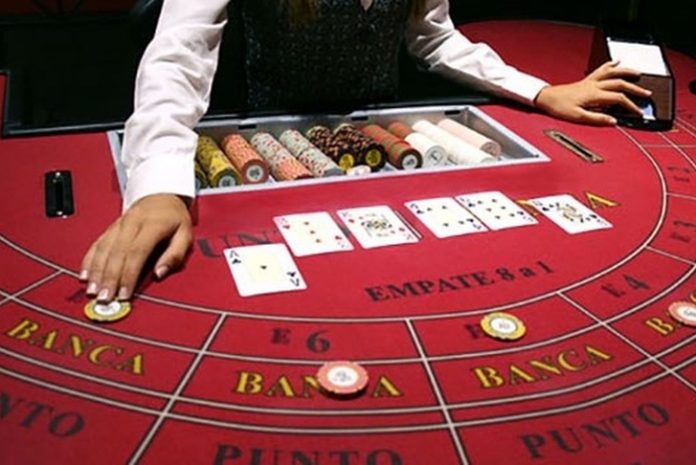
The game of baccarat generates over 1.3 billion dollars in gambling revenue annually across Asia-Pacific casinos alone — making it one of the most popular card games in the world. Understanding fundamental rules and strategic approaches to baccarat can significantly improve your chances of consistent wins.
Hand Rankings and Game Rules
SpinPanda Casino online and other premier gaming establishments — along with major global players like MGM Resorts and Las Vegas Sands — follow the same standardized baccarat rules refined over centuries. Baccarat is a comparing card game where you compete against the banker rather than other players.
The primary goal is to predict which hand will reach a value closest to nine without exceeding it. Each round packs three possible outcomes: the Player wins, the Banker wins or both hands tie.
The game uses six to eight standard decks of cards shuffled together. Card values are straightforward — numbered cards from two to nine hold their face value, tens and face cards count as zero, and aces are worth one point. The hand value is calculated by adding all card points and taking only the final digit. A hand containing a seven and an eight equals fifteen, which counts as five in baccarat.
Essential hand rankings for successful gameplay:
- Natural nine — an eight-point hand dealt in first two cards.
- Natural eight — a seven-point hand dealt in first two cards.
- Standing hands — any hand totaling six through nine requiring no additional cards
- Drawing hands — any hand totaling zero through five that must draw another card
- Bust potential — hands that could total ten or higher automatically lose one point value
Card Dealing and Drawing Procedures
The dealer controls all card distribution using predetermined drawing rules. Both the Player and Banker hands receive two initial cards. If either hand totals eight or nine — called a natural — the game ends immediately.
When neither hand achieves a natural, the Player hand acts first. If the Player hand totals five or less, they must draw a third card. If they stand with six or more, the Banker then acts according to their specific drawing rules.
Major global operators — from European casinos to Macau establishments — enforce these fixed rules consistently without requiring player decision-making at this stage.
Banker versus Player Betting Strategies
Strategic betting decisions form the cornerstone of baccarat success. The most critical choice involves where to place your money — on the Player hand, the Banker hand or the Tie outcome.
Statistical analysis reveals clear advantages in certain betting approaches that savvy players exploit consistently. Here is a comparison of the three main betting options available to you:
| Betting Option | Payout Ratio | House Edge | Recommended Strategy |
| Player Win | 1 to 1 | 1.24% | Use for variation but avoid over-reliance |
| Banker Win | 1 to 0.95 | 1.06% | Primary betting focus for long-term profit |
| Tie Outcome | 8 to 1 | 14.44% | Avoid completely unless specific conditions met |
The Banker bet crashes with the lowest house edge despite paying slightly less — mathematically superior for long-term profitability. Many experienced players dedicate seventy to eighty percent of their betting toward the Banker hand.
The Player bet fires slightly higher odds but increased house advantage. The Tie bet — while tempting with its eight-to-one payout — contains such a high house edge that most professional players and global market leaders completely avoid it.
Pattern Recognition and Streak Management
Baccarat players often track historical results to identify patterns and hot streaks. While each hand remains mathematically independent, tracking patterns helps manage your betting psychology and maintain discipline.
Many players keep scorecards showing whether previous hands favored the Player, Banker or resulted in ties. Global casinos — from Wynn to Venetian properties — encourage this common tracking practice among their baccarat clientele.
Bankroll Management and Risk Control Strategies
Proper bankroll management separates successful baccarat players from those who face financial losses. Your bankroll represents the total amount you can afford to lose without affecting your daily life.
Expert players — including high rollers tracked by international casino chains — recommend setting aside specific funds exclusively for baccarat gambling.
Essential bankroll management principles for sustainable gameplay:
- Set maximum betting limits at one to two percent of your total bankroll per hand
- Establish winning targets and loss limits before beginning each session
- Never chase losses by increasing bet sizes dramatically — avoid the tilt trap.
- Track all wins and losses to monitor your performance accurately
- Take regular breaks to maintain mental clarity and emotional control
- Avoid alcohol consumption while making betting decisions
Betting Systems and Mathematical Approaches
Various betting systems claim to improve baccarat outcomes. The Martingale system involves doubling your bet after each loss until you win — theoretically recovering losses.
However, this approach risks substantial capital on single hands. The Fibonacci system uses the mathematical Fibonacci sequence for more conservative betting increases. The 1-3-2-4 system structures your bets across four consecutive hands for controlled progression.
Global betting syndicates and professional players understand that no betting system eliminates the house edge. These methods primarily serve as frameworks for disciplined betting — not guaranteed profit generators.