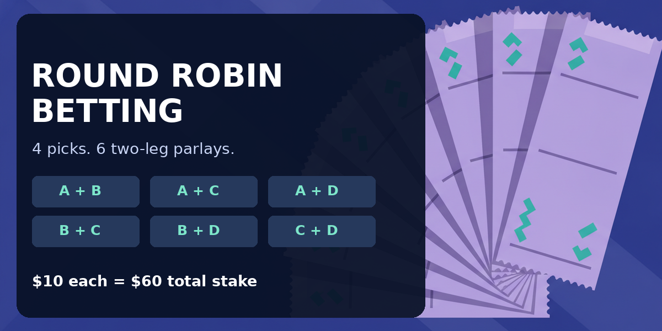
Round robin betting turns a group of picks into every possible smaller parlay combination. Each combination is placed as a separate bet on one slip. A single big parlay needs every pick to win; a round robin pays out on whichever smaller combinations land, while a losing combination simply forfeits its own stake. The tradeoff is cost: each combination is its own bet, so sizing up past a couple of picks adds up fast.
This is unrelated to the round robin schedule used in sports tournaments; the name only describes the parlay structure in betting. You can plug your own picks and odds into Wild.io’s round-robin bet calculator. It is a free tool that totals the combination count, stake and all-win payout for you. Working through the arithmetic once shows why some winning tickets lose money.
Key Takeaways
- A four-pick round robin by 2s only is 6 parlays, $60.00 total stake at $10 per parlay.
- By 3s only is 4 parlays, $40.00 total stake.
- Every combination from 2 picks up to 4 picks is 11 parlays, $110.00 total stake.
- On the by-2s ticket, every two-winner outcome still loses money overall.
- Three of the four picks need to win before the by-2s ticket shows a profit.
How Many Bets Does a Round Robin Actually Create?
A four-pick round robin “by 2s” alone creates 6 separate parlay bets, since four picks contain 6 unique pairs. That count is the binomial coefficient for choosing 2 items from 4, the standard way to count unordered combinations. It counts possible combinations, not measured betting results. Combination counts grow quickly as picks are added, and the total stake can look much larger than the pick count suggests.
| Picks | By 2s | By 3s | All combinations (2 to n) | Cost at $10 per parlay, all combinations |
| 3 | 3 | 1 | 4 | $40 |
| 4 | 6 | 4 | 11 | $110 |
| 5 | 10 | 10 | 26 | $260 |
| 6 | 15 | 20 | 57 | $570 |
| 7 | 21 | 35 | 120 | $1,200 |
| 8 | 28 | 56 | 247 | $2,470 |
Going from 4 picks to 5 picks more than doubles the full-combination cost, from $110 to $260. That jump is a clear sign round robin size deserves planning before you pick your games, not after.
What Does a Four-Pick Example Cost by Combination Size?
Say you like four separate games on a Saturday slate. The prices are A at -110, B at +150, C at -200 and D at +120. These are placeholder prices to show how the math behaves, not real events or a recommendation.
At $10 per parlay, these four picks price out as follows:
| Combination size | Parlays | Total stake at $10 each |
| By 2s only | 6 | $60.00 |
| By 3s only | 4 | $40.00 |
| By 2s and by 3s combined | 10 | $100.00 |
| All combinations, 2 through 4 | 11 | $110.00 |
Doing this math once shows a four-pick by-2s round robin costs six times a single parlay’s stake, not some smaller multiple.
What Does Each Outcome Actually Pay?
Betting the by-2s round robin on picks A, B, C and D at $10 per parlay produces 16 possible outcomes, each a different win and loss pattern shown in the table below. The 16 rows are mutually exclusive: exactly one win/loss pattern happens on game day. The six parlays behind those rows are a different matter, since they all draw from the same four picks and are not statistically independent bets.
| Winning picks | Combinations hit | Return | Net result |
| None | 0 | $0.00 | -$60.00 |
| A only | 0 | $0.00 | -$60.00 |
| B only | 0 | $0.00 | -$60.00 |
| C only | 0 | $0.00 | -$60.00 |
| D only | 0 | $0.00 | -$60.00 |
| A and B | 1 | $47.73 | -$12.27 |
| A and C | 1 | $28.64 | -$31.36 |
| A and D | 1 | $42.00 | -$18.00 |
| B and C | 1 | $37.50 | -$22.50 |
| B and D | 1 | $55.00 | -$5.00 |
| C and D | 1 | $33.00 | -$27.00 |
| A, B and C | 3 | $113.86 | +$53.86 |
| A, B and D | 3 | $144.73 | +$84.73 |
| A, C and D | 3 | $103.64 | +$43.64 |
| B, C and D | 3 | $125.50 | +$65.50 |
| All four | 6 | $243.86 | +$183.86 |
Look at the two-winner rows: every one is still a net loss, from -$5.00 to -$31.36. For example, if only B and D win, their pair returns $55.00. The other five parlays lose, and the full ticket cost $60.00, leaving a $5.00 net loss. A winning pair is not the same as a profitable ticket.
These are original calculations from the hypothetical prices above, with each outcome’s aggregate return rounded to cents. A sportsbook’s settlement rounding may differ. No pair here returns enough to cover all six stakes, but that is not a universal rule: a winning pair at longer odds could cover the entire ticket instead.
When Does the Whole Ticket Come Out Ahead?
On this exact slate, the by-2s round robin needs three of the four picks to win before it shows a profit. Zero-winner and one-winner results lose the full $60.00. Two-winner results still lose once weighed against all six parlays. Three-winner and four-winner results turn a profit, topping out at +$183.86 if all four land.
This threshold is specific to these prices and this combination size, not a fixed rule. A by-3s round robin on the same picks needs all three in a trio to win, since a three-leg parlay has no partial win. Change the odds, size or pick count, and the winners needed to break even changes too.
Does a Round Robin Remove the Sportsbook’s Margin?
No. A round robin is built entirely from parlays priced using the sportsbook’s own odds. Spreading those prices across more, smaller bets does not remove whatever margin is already built into each one. This example shows how that margin compounds across legs. Assume purely for this example that a -110 leg has an independent 50 percent chance of winning. That is a simplified hypothetical, not a measured margin.
Under that hypothetical assumption only, one -110 leg has an expected net return of roughly -0.0455 per dollar staked. A two-leg parlay works out to about -0.0888 per dollar, and a three-leg parlay works out to roughly -0.1303. The break-even win probability for a single -110 leg is about 0.5238. These figures describe one hypothetical scenario, not a claim about every real -110 bet’s margin. The same logic applies no matter how the picks are grouped into a round robin: stacking more legs onto a single combination compounds the built-in margin further, it does not erase it.
How Do Voids, Pushes and Same-Game Picks Work?
Sportsbooks apply their own rules when a pick voids, pushes, or shares a game with another, and those rules are not uniform across operators. There is no single settlement outcome you can assume applies everywhere, so this section covers the general concepts rather than any one book’s exact wording.
First, check which combinations are eligible. The tables above use four separate games and assume all six pairs can be placed. If a ticket includes selections from the same game, do not assume the raw combination count is still the number charged. Read the book’s restrictions and compare the eligible combinations, bet count and total stake shown in the final preview before confirming.
Next, check how the book settles a void or push within each combination. Look for whether a leg is removed and the remaining odds recalculated, whether the affected combination is refunded, and whether a minimum-leg rule applies. These are questions to resolve from the current rules, not interchangeable outcomes to assume. A void or push is not automatically the same as a losing selection.
The worked outcome table assumes every pick either wins or loses. It does not price voids, pushes, dead heats or restricted same-game pairings. If any of those could affect a ticket, confirm the settlement treatment before using the table as a model for it.
What Can a Round-Robin Calculator Tell You?
A round-robin calculator is useful for one job: it turns picks, odds and stake into the correct combination count, total cost, and all-win payout, saving hand-counting each time a pick or stake changes.
Automated interface check, 14 October 2026: entering the same four selections (-110, +150, -200, +120) into the by-2s-only option at $10 per parlay displayed 6 bets and a $60.00 total cost. It also displayed a $243.86 all-win return and a $183.86 all-win profit. This is a software-interface observation, not a human casino session, a partial-settlement outcome, or a probability verification.
What a calculator like this does not do is model pushes, voids, partial-win probabilities, or same-game restrictions, and it will not estimate the real chance that three of four picks win. Treat any combination and cost total as a starting point, not a complete picture.
How Can You Bet Within Your Means?
Round robins can look deceptively affordable since each combination is small. The total across six, ten or more parlays adds up fast, as the tables above show.
Before building one, total the full cost of every combination you plan to include, not just the smallest-looking size. If that total is more than planned, options exist: lower the stake, use fewer picks, drop combination sizes, or skip the bet. None of these change the odds; they only change the risk.
Betting is for adults only, and only where it is legal. Set a budget first, and stop if you reach it.
Frequently Asked Questions
How much does a round robin cost?
It depends on how many picks you include and which combination sizes you choose. A four-pick round robin by 2s is 6 parlays, or $60.00 total at $10 per parlay. Every combination from 2 picks through all 4 picks together is 11 parlays, or $110.00 at the same stake.
What does “by 2s x3 wagers” mean?
It means the round robin uses two-pick combinations only, and in this example there are three of them. Each combination is charged separately. Three two-pick combinations at $10 each cost $30.00 total, not $10 for the whole slip.
How many bets is a round robin on five picks?
A five-pick round robin by 2s alone creates 10 separate parlay bets. A group of five picks contains 10 unique pairs. Betting every combination size from 2 picks through all 5 grows that to 26 total parlay bets.
Is a round robin worth it?
There is no single answer, since it depends on the odds, combination size, and how many picks win. In the four-pick example above, every two-winner outcome on the by-2s ticket still loses money. Three of the four picks must win before the ticket turns a profit.
What happens if one pick pushes?
Check the operator’s current rules before assuming an outcome. Find out whether the pushed leg is removed and the remaining odds recalculated, whether the affected combination is refunded, and whether a minimum-leg rule applies. Do not treat a push as an automatic loss or assume that every sportsbook handles it identically.