

Prediction markets have rapidly evolved from niche experiments into powerful platforms for aggregating public sentiment and forecasting real-world outcomes. Platforms like Polymarket have demonstrated how users can trade on the probability of events, from elections to economic indicators, using decentralized infrastructure. At the heart of such platforms lies a critical component: the API.
Understanding what a Polymarket API is and how it works is essential for anyone exploring polymarket clone software development or building advanced prediction market platform solutions.
What Is a Polymarket API?
A Polymarket API (Application Programming Interface) is a set of protocols and endpoints that allow developers, applications, and external systems to interact with a prediction market platform programmatically.
Instead of manually placing trades or checking market data through a user interface, APIs enable automated access to core platform functionalities such as:
- Retrieving live market data
- Accessing price movements and probabilities
- Executing trades programmatically
- Monitoring user positions and balances
- Managing market creation and settlement
In simple terms, the API acts as a bridge between the platform’s backend engine and external applications, making the system scalable, extensible, and developer-friendly.
How Does a Polymarket API Work?
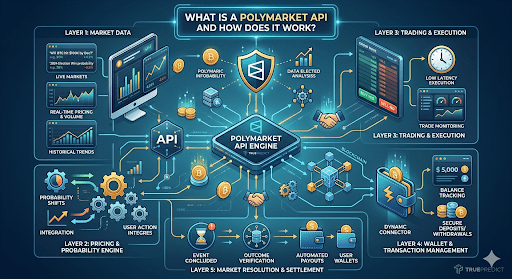
To understand how a Polymarket API functions, it helps to break down the process into key layers:
1. Market Data Layer
At its core, a prediction market is driven by real-time data. The API continuously exposes:
- Active markets (e.g., “Will BTC hit $100K by December?”)
- Current prices (representing probability)
- Trading volume and liquidity
- Historical price movements
Developers can fetch this data through endpoints, enabling dashboards, analytics tools, or third-party integrations.
2. Pricing & Probability Engine
Unlike traditional betting systems, prediction markets operate on dynamic pricing models. Prices shift based on user demand.
The API reflects this in real time by:
- Updating odds as users buy/sell positions
- Maintaining liquidity through automated market-making mechanisms
- Providing instant price quotes before trade execution
This is what makes prediction platforms feel “alive”, and the API is the delivery channel for that intelligence.
3. Trading & Execution Layer
One of the most critical functions of a Polymarket API is enabling trade execution.
Through secure API calls, users or systems can:
- Buy “YES” or “NO” shares
- Sell positions before market resolution
- Track open orders and trade history
For developers building prediction market platform solutions, this layer is where user interaction meets backend logic. Speed, accuracy, and reliability are essential here.
4. Wallet & Transaction Management
Prediction markets often integrate digital wallets, especially in crypto-native environments.
The API facilitates:
- Wallet connections and authentication
- Balance tracking
- Deposits and withdrawals
- Transaction confirmations
In decentralized setups, this layer may interact with blockchain networks, ensuring transparency and immutability.
5. Market Resolution & Settlement
Once an event concludes, the platform must resolve the market and distribute payouts.
The API plays a key role by:
- Triggering outcome resolution
- Updating market status (open → closed → settled)
- Crediting winnings automatically to user accounts
This automation is crucial for maintaining trust and operational efficiency.
Why APIs Are Critical in Prediction Market Development
For businesses exploring polymarket clone software development, APIs are not just a technical feature, they are the backbone of scalability and innovation.
Here’s why:
✔ Automation & Speed
APIs allow platforms to process trades, update prices, and settle outcomes instantly without manual intervention.
✔ Integration Flexibility
You can integrate with third-party tools like analytics dashboards, payment gateways, or compliance systems.
✔ Custom Frontends
With a strong API, you can build multiple user interfaces (web, mobile, partner apps) on top of the same backend.
✔ Data Accessibility
Developers and traders can build their own tools, bots, or strategies using live market data.
Key Considerations When Building a Polymarket-Like API
If you’re planning to develop your own prediction platform, the API architecture must be designed carefully. Some essential considerations include:
- Low Latency: Real-time pricing demands fast response times
- Security: Authentication, encryption, and fraud prevention are critical
- Scalability: The system should handle high trading volumes seamlessly
- Compliance: Regulatory and regional requirements must be integrated
- Reliability: Downtime or incorrect settlements can damage user trust
A well-designed API ensures that your platform is not just functional but competitive in a rapidly growing market.
The Future of Prediction Market APIs
As prediction markets expand into finance, sports, politics, and even AI-driven forecasting, APIs will play an even bigger role. We’re already seeing trends like:
- AI-powered prediction insights
- Cross-platform liquidity sharing
- Real-time data feeds for institutional use
- Deeper blockchain integration
This evolution makes robust API infrastructure a necessity, not an option.
Conclusion
A Polymarket API is far more than a technical connector, it is the engine that powers real-time interaction, dynamic pricing, and seamless user experiences in modern prediction platforms.
For businesses investing in prediction market platform solutions or exploring polymarket clone software development, building a strong, scalable API is the foundation of long-term success.
At TruePredict, we specialize in developing high-performance prediction market platforms with robust backend systems, real-time trading logic, and scalable API architectures, helping businesses build platforms that don’t just function, but truly stand out.