Long before 2026, poker had already split into two increasingly separate games, and American players who move between them keep learning that lesson the hard way. The rules of Texas Hold’em have not changed. What shifts is everything around the cards: the speed of play, the information available, the read on an opponent, and even the route a player takes to reach a seat. Across the handful of states that now allow the online game, and in the free-to-play formats available almost nationwide, the digital version has drifted far enough from the felt that treating the two as one game is a mistake.
Access is where it starts, because so much of the rest follows from it. A live game demands a card room, a drive, and a physical buy-in at the cage, which across most of the country still means a permitted casino floor or a tribal property hours away. The online game asks for a laptop or a phone, and increasingly it does not even ask for cash up front. Sweepstakes rooms let players run through real poker mechanics purely for entertainment, and a free sc casino no deposit bonus has become a common on-ramp to the digital game rather than the rare promotion it once was. The barrier to sitting down has all but collapsed.
A live table deals maybe thirty hands an hour, slowed by shuffling, chip stacking, and players agonizing over easy decisions. Online, a single table moves at roughly double that pace, and a seasoned grinder may run four, six, or a dozen tables at once. Where a live player watches thirty hands go by in an hour, an online player can see several hundred. That volume compresses experience, so the lessons that took a live regular years to absorb tend to land online in a matter of months.
Look at the menu of formats and the gap widens again. A live room offers whatever the schedule allows, usually a handful of cash tables and a nightly tournament. Online, a player toggles between cash games, sit-and-gos, large-field tournaments, and fast-fold variants that whisk you to a fresh hand the instant you muck. The variety is part of the appeal, and it also means the two environments reward different habits of patience, focus, and stamina.
Then comes the question of what a player can actually read, which is where the older skills either matter or evaporate. Live poker rewards the classic ones: watching a hand tremble, timing a stare, catching the shift in a shoulder. Behavioral researchers have found that observers can judge the strength of a holding from a player’s arm movements alone, which is part of why reading a rival’s body language stays a live-only edge. Online, all of that disappears behind an avatar and a countdown clock, and the physical intuition that carried a live player for years suddenly counts for nothing.
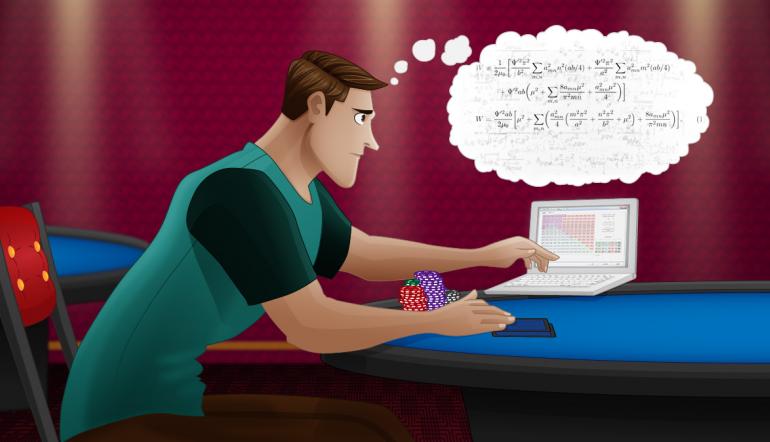
Bet-sizing patterns, timing tells, and the rhythm of the clicks take over from the physical read. Plenty of grinders lean on tracking software that logs every hand an opponent has played, turning the table into a live spreadsheet of tendencies and frequencies. The tell has not disappeared. It has simply migrated into the data, where it rewards whoever studies hardest away from the table.
The math underneath has grown heavier too, and this is the part that quietly reshapes the whole online field. Once an AI that beat professional poker players proved the game could be modeled at a superhuman level, the study tools built on that research trickled down to ordinary online play. Solvers now sit on the desktop of any serious player, and the online game has turned noticeably more precise, more theory-driven, and less forgiving of loose habits than the average live room. Nobody coasts on feel anymore; the field has read the same charts.
What none of this touches is the part live players guard most closely, which is the room itself. The riffle of chips, the read across a felt table, the slow theater of a big pot are textures a screen cannot reproduce. Online poker swaps that atmosphere for convenience and pace, and the trade is not neutral. Which version counts as real poker depends entirely on what a person wants out of an evening, and honest players on both sides will admit the answer is not obvious.
Geography still decides how much of any of this a player can legally attempt. Sanctioned online poker in the United States sits in a small cluster of states, with a shared-liquidity agreement letting several of them pool players across state lines so the games stay populated through the slow hours. Everywhere else, the free-to-play and sweepstakes formats fill the gap for anyone curious about the mechanics without a nearby card room. Either way, the strategic demands run steep enough that many newcomers spend their first stretch simply refining their poker strategy before deciding which environment actually suits them.
The uncomfortable truth is that the two games are pulling apart fast enough that a player can master one and stay a tourist in the other. Felt and screen now reward almost opposite instincts, and the crossover player who assumes the transfer is automatic is usually the softest seat in either room.