The sportsbook and the casino both take a cut. The difference: one of those cuts can be beaten, and the other never will be.
Nobody sells you a bet at a fair price. Ever. Every wager carries a built-in tax, and the house collects it whether you win or lose. Sharp bettors obsess over that tax. They have to. Its size decides how good you need to be just to break even. Casual players never look at it, and that blind spot is the whole business model. Two words cover most of what is going on: the vig at the sportsbook, and the house edge at the casino. They do the same job. They are not the same thing. And the space between them is where beating the house turns from a slogan into something real, or stays a pipe dream forever.
Every bet pays a toll: the vig and the house edge, side by side
Think of every gambling product as a toll road. You pay to get on. The toll is baked in before kickoff. At a sportsbook, that toll is the vig, the juice, the little markup sewn into the odds so the book wins no matter which side covers. In a casino game like a chicken road casino crash round, the toll is the house edge, carved straight out of the multiplier so the math leans a hair toward the operator every single time. Same job. Different costume. One is a markup on a number a person set by hand. The other is a fixed part of a sealed math model. That gap is the whole story, and most bettors walk right past it.
Pin down the two words first. The vig shows up in prices like -110 on each side of a two-way market. You lay 110 to win 100. That extra ten is the cost of entry, and the book’s margin on the market is called the hold. The house edge runs the other direction. It is the cut of every dollar wagered that the game keeps over time. Casinos like to dress it up as a return-to-player number, which is just 100 percent minus the edge. A 5 percent edge and a 95 percent RTP are the same game in different clothes. Both answer one question. Of all the money that runs through this thing, how much does the operator keep?
How the vig works inside a sportsbook
A book does not need to call games right. It needs to balance them. Picture a spread at -110 on both sides. If the money splits evenly, the book pays winners out of the losers’ stakes and keeps the gap stitched into that -110. That gap is roughly 4.5 percent of everything wagered, win or lose. It is called the hold. It is also why lines move. Too much cash on one side, and the book shifts the number to drag action back the other way. So a bettor is not really fighting the other team. A bettor is fighting a price that has been bent on purpose, so the house gets paid whichever way the result lands.
Reading the hold in a two-way market
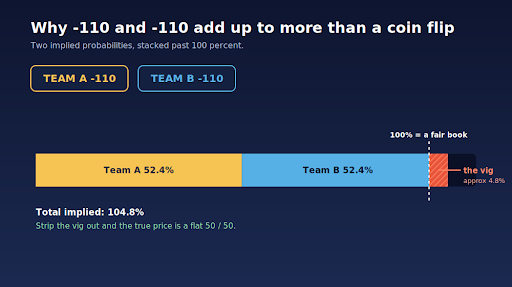
The math here is quick. Do it by hand once and it sticks. Take each side of a -110 market and turn it into an implied probability: 110 divided by 210, or about 52.4 percent. Now add both sides. The total is roughly 104.8 percent, not 100. That extra 4.8 percent is the overround, the book’s thumb on the scale. Strip it out and the true no-vig price on a -110 market is a flat coin flip. Run the same check across a few books and the value pops right out. One shop charges more, another charges less, and the bettor who always grabs the cheaper price keeps more of every win across a season.
How the house edge works in casino games
Casino games skip the balancing act. The edge is welded into the rules. American roulette is the classic example. The wheel has 38 pockets, but a winning straight-up number pays as if there were only 36. That mismatch hands the house a flat 5.26 percent on almost every bet at the table. Blackjack is gentler. Play perfect basic strategy and the edge drops to around half a percent, which is exactly why the pit watches card counters. Crash games such as Chicken Road run the same trick in a slicker shell. Most quote a return-to-player up in the high nineties. That leaves a low-single-digit edge tucked inside the bust odds and the capped multiplier, skimming its cut every round whether you cash out in time or not.
The difference that matters: one cut can be beaten, the other can’t
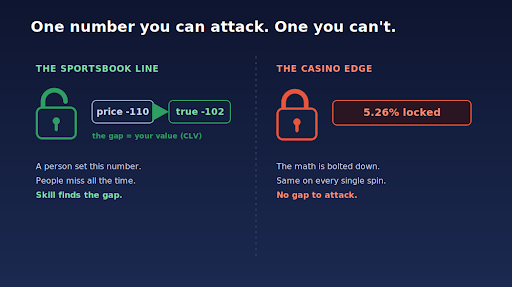
This is where the two tolls split for good. The vig sits on a number a person set. People get numbers wrong constantly. An oddsmaker misreads an injury, a back-to-back, a backup quarterback. A bettor who reads it better finds a price worth more than it costs, vig and all. That is the whole point of advantage play, and closing line value is the scoreboard that proves it over time. The house edge gives you none of that. A roulette wheel has no opinion to exploit and no soft number to hit. The math is fixed, audited, and the same on every spin. Skill changes nothing, because there is no mispriced line to beat. Just a fee for the fun.
Where each cut hides, and whether skill can touch it:
| Product | Typical cut | Can skill beat it? |
| Standard -110 point spread | About 4.5% hold | Yes, by finding mispriced lines and value. |
| Parlay | Much higher effective hold | Rarely, the combined margin compounds against you. |
| American roulette | 5.26% house edge | No, the math is fixed on every spin. |
| Blackjack with basic strategy | About 0.5% house edge | Only by counting, which casinos limit. |
| Crash game | A few percent, baked into the curve | No, the bust math does not bend to a player. |
What this means for your bankroll
It all comes down to one move. Let the source of the toll decide where the money goes. On the sports side, line shopping is the cheapest edge there is. Trim the vig from 4.8 percent to 3 percent over a season and that is free money, with no extra handicapping required. Dodge the products with a brutal built-in margin too, parlays first among them. On the casino side, the honest play is simpler. Treat a fixed-edge game, roulette or a Chicken Road round, as paid entertainment with a price tag you already know. Never as income. The edge always collects in the end. The only real choice left is how much fun the bill buys.
A few rules straight from the math:
- Shop every bet across books and take the lowest vig, because the smaller toll stacks up in your favor all year.
- Treat parlays as a fun flier, not a plan, since the margin piles on with every leg you add.
- Track your closing line value, the one number that shows whether you are really beating the price or just running hot.
- Set a fixed budget for fixed-edge games, then walk when it is gone, because no hot streak rewrites the math.