

A team can look unbeatable on paper and still struggle on matchday. Maybe its leading scorer is unavailable, two regular defenders are being rested, or the coach has changed the formation for a difficult away fixture. Suddenly, that comfortable-looking favorite becomes a much more complicated proposition.
This is why a good soccer betting strategy starts long before the referee blows the whistle. Looking at recent results is useful, but understanding who will actually play, how the teams match up, and whether the odds reflect that information is just as important.
The goal isn’t to predict every result correctly. It’s to make more informed decisions, recognize uncertainty, and know when a match is better left alone.
Why Team News Matters in Soccer Betting
Imagine two clubs preparing for a weekend match. The home team has won four of its previous five games, while the visitors have struggled to score. At first glance, the home side seems like an obvious favorite.
But there’s a problem: its first-choice goalkeeper is injured, its most influential midfielder is suspended, and the starting striker played a demanding European fixture just three days earlier.
Those details can change the match considerably.
Soccer is a low-scoring sport, so individual moments often carry enormous weight. Losing a key player doesn’t automatically mean a team will lose, but it may affect how the side creates chances, defends transitions, or manages possession.
Before evaluating a betting market, consider three questions:
- Who is available? Injuries, suspensions, and squad rotation can weaken particular areas of the team.
- How will the team play? A change of personnel may lead to a different formation or tactical approach.
- Has the market already reacted? Publicly known absences may already be reflected in the odds.
The third question is especially important. Correctly identifying a weakened team does not automatically mean the available betting price is favorable.
Predicted Lineups vs. Confirmed Starting XIs
One common mistake in soccer betting analysis is treating predicted lineups as official information.
A predicted lineup is an informed estimate based on recent selections, injury reports, tactical preferences, and other available evidence. It can be useful for early research, but it isn’t a guarantee of who will start.
A confirmed starting XI provides much stronger evidence. It identifies the players selected for the match, although it doesn’t guarantee precisely how they will perform or how the team will play.
For Premier League research, matchxi.com provides a useful starting point for checking fixtures, predicted lineups, officially confirmed starting XIs when available, and relevant team news.
When reviewing a lineup, don’t focus only on the biggest names. Consider the positions and responsibilities of the missing players.
For example, a defensive midfielder who protects the back four may be more important to the team’s structure than a winger with better individual statistics.
Likewise, two reserve fullbacks starting together could affect how effectively a team defends wide areas.
A strong pre-match opinion should be flexible enough to change when the official lineup provides new information.
The important distinction is between what you expect to happen and what has actually been confirmed.
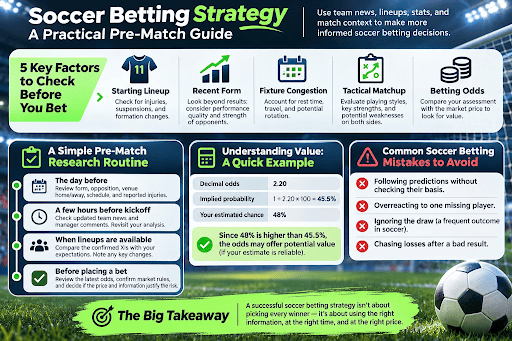
Five Factors to Check Before Placing a Soccer Bet
A practical soccer betting strategy combines team news with broader match context. No single statistic tells the whole story.
The following table shows how different factors can influence the assessment of a match.
| Factor | What to examine | Why it matters |
| Starting lineup | Missing regular starters, replacements, formation | Changes may affect attacking or defensive performance |
| Recent form | Quality of opposition, underlying performances, home and away results | Winning streaks can hide weak performances |
| Fixture congestion | Short rest periods, travel, upcoming matches | Fatigue and rotation may affect intensity |
| Tactical matchup | Pressing styles, defensive weaknesses, set pieces | Some opponents create particularly difficult matchups |
| Betting odds | Current prices, implied probabilities, recent movement | A reasonable prediction can still be a poor-value bet |
1. Look Beyond the Last Five Results
A five-game winning streak sounds impressive, but context matters.
Did those victories come against opponents near the bottom of the table? Did the team dominate possession and create good chances, or did it rely on excellent finishing and goalkeeping?
Expected goals (xG), shot quality, chances conceded, and opposition strength can provide additional context.
However, advanced statistics aren’t magic. They describe particular aspects of past performances rather than guaranteeing future results.
2. Consider Home and Away Differences
Some teams press aggressively and dominate possession at home but play more cautiously away from their own stadium.
Others are especially effective on the counterattack, making them dangerous against opponents that leave space behind their defensive line.
Reviewing performances separately by venue can reveal patterns that overall league statistics may hide.
Avoid relying on very small samples, though. Three impressive home victories do not necessarily establish a reliable long-term trend.
3. Understand the Tactical Matchup
A high defensive line against fast counterattacking forwards can create opportunities for the opposition.
Similarly, a team that struggles to defend crosses may have difficulties against opponents with strong aerial players.
These observations are useful only when supported by evidence. A tactical advantage should be treated as one factor in the assessment, not as a certain outcome.
4. Account for Rest and Rotation
Schedule congestion is particularly relevant for clubs competing in domestic leagues, European tournaments, and cup competitions.
A manager might rotate several starters after a demanding midweek fixture. Alternatively, the team could retain its strongest lineup despite limited recovery time.
Consider the actual schedule and player availability rather than assuming every club responds to congestion in the same way.
5. Compare Your Assessment With the Odds
This is where match research becomes a betting decision.
A strong favorite may be the most likely winner, yet the available odds could offer little value. Conversely, an underdog can have a reasonable chance of producing an upset without necessarily being a worthwhile selection.
The critical question isn’t simply, “Who will win?”
It’s whether the offered price fairly reflects the probability of the outcome.
How to Understand Value in Soccer Betting
Every betting price implies a probability.
For decimal odds, the basic calculation is:
Implied probability = 1 ÷ decimal odds × 100
For example, odds of 2.20, equivalent to +120 in American odds, imply a break-even win probability of approximately 45.5%, before considering other market prices and bookmaker margin.
Suppose your independent analysis estimates a team’s chance of winning at 48%.
On paper, that estimate is slightly higher than the probability implied by the odds. But there’s an important catch: your estimate may be inaccurate.
Player absences, tactical assumptions, statistical uncertainty, and unexpected match events can all affect the result.
A difference of just a few percentage points is not automatically evidence of an advantage.
This is why experienced analysts pay attention to both their estimated probabilities and how uncertain those estimates are.
Also remember that traditional soccer 1X2 markets include three possibilities: home win, draw, and away win. A draw must be accounted for when estimating either team’s chances.
A Practical Example: When Lineup News Changes the Picture
Consider a hypothetical Premier League matchup.
Team A is playing at home and has been performing well. Team B has struggled away from home and recently conceded several goals.
An initial review suggests Team A deserves to be favored.
Then, approximately an hour before kickoff, the official lineup reveals two changes:
- Team A’s primary defensive midfielder is unavailable.
- Its first-choice center forward has been replaced by a less experienced attacker.
These changes do not mean Team A is suddenly likely to lose.
However, they raise questions worth investigating.
Without its usual defensive midfielder, Team A might be more vulnerable to counterattacks. Without its regular striker, the team may create chances differently or have less reliable finishing.
The next step is to examine how the replacements have performed, whether the tactical system is likely to change, and how the betting market has responded.
If the available information creates too much uncertainty, the appropriate decision may be to avoid the match entirely.
That is still a successful application of a disciplined research process.
Common Soccer Betting Mistakes to Avoid
Even detailed match analysis can be undermined by poor decision-making.
Following Predictions Without Checking Their Basis
Free picks and expert opinions can offer useful perspectives, but they should not replace independent research.
Look for explanations that discuss team availability, match context, relevant statistics, and the odds being evaluated.
A confident prediction without supporting reasoning provides little information about its reliability.
Overreacting to One Missing Player
A star player’s absence often attracts attention. Yet the replacement, the team’s tactical flexibility, and the opponent’s strengths all matter.
Some teams have sufficient squad depth to compensate effectively, while others rely heavily on particular individuals.
Avoid assuming that every major absence should produce the same adjustment.
Ignoring the Draw
Unlike many major American sports, soccer frequently ends with neither team winning.
That makes the distinction between a three-way moneyline (1X2), draw-no-bet, and other market formats especially important.
Always understand the settlement rules before interpreting the offered price.
Chasing Losses
Increasing stakes after losing bets does not make the next prediction more accurate.
A losing streak is not evidence that a winning outcome is somehow due.
Predetermined limits and consistent decision-making are more useful than attempting to recover losses through increasingly risky selections.
A Simple Pre-Match Research Routine
You don’t need a complicated spreadsheet or an expensive statistical model to develop a more organized research process.
A repeatable checklist can make it easier to identify important information and avoid impulsive decisions.
The day before the match
Review recent results, the quality of opposition, home and away performances, the fixture schedule, and reported injuries. Identify any assumptions that depend heavily on the starting lineup.
A few hours before kickoff
Check updated team news and manager comments. Review whether the initial tactical assessment still makes sense.
When official lineups become available
Compare the confirmed teams with your expectations. Pay particular attention to unexpected absences, positional changes, and combinations of players who rarely start together.
Immediately before making a decision
Review the latest available odds, confirm the market rules, and decide whether the price and information justify the risk. If the assessment remains unclear, skip the wager.
Keeping a record of your reasoning can also help identify recurring analytical mistakes over time.
Does More Research Guarantee Better Results?
No. Even a carefully researched selection can lose.
Soccer matches involve unpredictable events: deflections, red cards, penalties, individual errors, and moments of exceptional skill.
Better information can help people evaluate uncertainty more systematically, but it cannot eliminate uncertainty or guarantee profitable betting.
A useful approach is to distinguish between the quality of a decision and the outcome of a single match.
For example, a bet can win despite being based on weak reasoning. Another can lose even when the analysis was careful and the price appeared reasonable.
Neither result, on its own, proves that the underlying approach was good or bad.
Anyone who chooses to bet should use money they can afford to lose, establish financial limits, and follow the legal requirements in their jurisdiction.
Final Thoughts
A good soccer betting strategy is less about finding a secret formula and more about consistently asking the right questions.
Who is available? How do the teams match up tactically? Does recent form tell the whole story? And, perhaps most importantly, does the betting price reflect the information you have gathered?
Starting lineups, player availability, match statistics, and scheduling context are pieces of the same puzzle. Examining them together provides a more useful perspective than relying on a winning streak or a single expert prediction.
The best habit is to remain willing to revise your assessment when new evidence appears — and to recognize that sometimes the smartest decision is not to bet at all.