
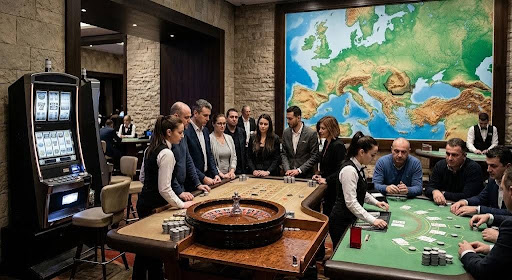
What is supposed to be a simple question, “What is the most popular casino game?”, becomes complicated when looking at the numbers. Slot games make up about 78% of the online casino gross gaming revenue (GGR) in Denmark, and about 82% in Great Britain, where the Gambling Commission reported that of the $5 billion in online casino GGR, $4.2 billion was from slot games. However, these numbers do not reflect what is happening at the session level. Slot games have a much lower average stake than live games. This is because slots are designed to be quick and cheap, while live games have a higher stake per round. By the number of sessions, slots win by a landslide, but if you look at the money committed per round, live games win by a landslide as well. Player preference surveys tell a different story, and in a lot of markets roulette ranks higher than a revenue-only analysis would suggest. Whatever data you look at first, it ignores everything the other data would have told you.
Romania is the best place to look at these numbers because the discrepancies between the data are the largest in Europe at this point.
Romania: Where the Money Really Flows
In a single year, bank card payments for gambling in Romania totaled 12.5 billion lei (roughly €2.5 billion). This created the largest category of online payments in the country. In fact, for every 100 lei spent online, 12.5 lei were spent on gambling.
Online casino games account for roughly 36% of Romania’s total market. Romanian gamblers tend to prefer the classic style of slots, including fruit machines and other games similar to the ones found in physical casinos. Slots lead in both session count and GGR, with poker maintaining a 2% market share. Recently, live casino games (blackjack and roulette) and other game shows have grown in popularity, meaning the revenue for those categories will also grow.
It’s not difficult to describe abstractly the measurement gap between GGR share and session count, but it’s a different story when you can physically see a licensed market’s entire game catalog. Every format, every stake level, every pace of play, all presented in one place. Currently, that full range is available in the Romanian licensed market, and it is documented at this link: https://don.ro/ro/. That range illustrates the most important conflict when analyzing GGR: a €0.50 slot spin and a €40 live roulette hand both end up on the same GGR line, but there is such a significant difference in the player relationship to the game, as well as the player’s appetite for risk, the volume of play, and the player’s reasoning for playing the game.
A Market in Visible Transition
What makes Romania so interesting is the age group that drives the entire industry. The 18-24 age group is the most active, accounting for a third of all gamblers in a given week, and is followed closely by the 25-34 age group. A market dominated by younger players is heavily focused on slot games, which is a carryover from land-based gaming, while this demographic is also heavily oriented toward live dealer games once the products reach maturity. So in that regard, Romania is a market in visible transition, and the GGR figures are already reflecting the change.
Slots and the volume paradox
The data from SOFTSWISS Game Aggregator adds more definition. During the same time period, the average bet for live dealer games was €49.95, and for slots it was €0.75. For the same player base, live dealer games represent a sixty-six-fold increase in the financial commitment for each game round.
Slots accounted for 85.56% of the aggregator’s total GGR during the same time frame. While this number is eye-catching, it doesn’t mean much without additional context. When it comes to revenue share, it is volume, not unit-bet size, that determines the share. Thousands, or even millions, of low-cost spins can net more revenue than hundreds of high-stakes table game hands. Slots maintain this fast revenue-generating capacity by offering a high volume of sessions and a rapid pace of betting. This makes slots the dominant game in terms of GGR and the game with one of the lowest average wager sizes.
This is important for anyone interpreting popularity data because session count and GGR can trend in the same direction (with slots leading in both) despite measuring different things. A game generating 85% of GGR on an average bet of €0.75 has a different player profile from a game generating 8% on an average bet of €40. The Denmark data provides a good example. In 2024, the online casino segment of Denmark, one of the best-documented segments in Europe with game-level data published by the regulator, reported a GGR of DKK 3,529 million (roughly €475 million), a 14.5% increase from the previous year. Slots accounted for 77-78% of this total, with Blackjack at 6.7% and Roulette at 6.4%. By revenue, the ranking is clear. However, the average bets for Table Games are many times larger than the average slot bet, meaning a small number of Table Game players account for a large portion of the money in play.
Roulette’s place in the European story
In terms of GGR, Roulette’s numbers are unimpressive. In Denmark it is at 6.4%, in the UK it is roughly 8%. Compared to slots, these numbers are insignificant. The main question is why Roulette has a stronger session share than Blackjack and other Table Games, and why player surveys place Roulette higher than a revenue-only analysis would warrant?
One part of the answer is the average stake. Slot players stake a comparatively low amount per spin, while roulette players stake a significantly higher amount per round, especially in live formats. The UK data is useful here. In the latest Gambling Commission report, roulette made up 7.9% of the total Online Casino GGR, approximately $340 million, and 13.7% of the total turnover, approximately $14.5 billion, meaning that $14.5 billion in total bets were placed on roulette. The GGR to turnover ratio of roulette reflects high stakes relative to what the operator retains. The house edge in roulette is low and comparatively fixed, so a large amount of money is cycled through the game and a smaller amount is retained as revenue.
Roulette’s weight in other countries in Europe is evident, but the case of Spain is the clearest. In the Spanish market, live roulette is the second largest category of revenue in the online casino market at €208.8 million, behind slots at €472.2 million. Traditional roulette at €24.9 million brings the total roulette category to €234 million, which is more than 30% of what slots produced, despite receiving a fraction of the marketing dollars. Live roulette also had a year on year growth rate of 10.41% in Spain, which was one of the highest growth rates of all categories. In a market where slots make up the large majority of the total revenue, the growth of roulette indicates where player interest is moving.
Blackjack and the GGR Gap
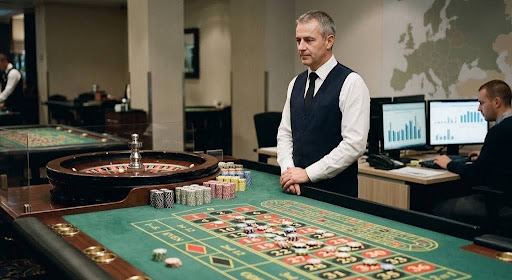
Blackjack is a unique case when comparing the GGR data to player preference data. In the latest reported data from the UK, blackjack accounted for 3.7% of the total GGR from online casinos, approximately $161 million. This may seem like a large number, but blackjack only accounted for 6% of the total casino game turnover, meaning that $6.5 billion worth of bets were made on blackjack. Compared to other casino games, blackjack has a relatively low GGR to turnover rate of 2.5%, which means that for every dollar bet on blackjack, the casino only keeps 2.5 cents.
A low GGR to turnover rate means that, on average, players are betting much more than the casino is making. This is especially true for blackjack as it is a skill-based game and players can significantly improve the outcome of a game by using basic strategy, which can reduce the house edge to less than 0.5%. Because of this, players who use basic strategy are typically players who place large, infrequent bets, as opposed to players who place many small bets. In the well-documented Danish market, blackjack, at 6.7% of the total GGR, is actually higher than roulette at 6.4%. This means that in that market, blackjack ranks second by GGR, behind only slots.
This highlights why blackjack tends to perform poorly in terms of GGR. It is precisely this characteristic that draws the odds-savvy crowd. For the player who has absorbed the math of the game, blackjack provides an outlet to express their skills and make decisions that carry real-world consequences. This player type is distinct from the slot player and the roulette player, and is evident in player surveys across different markets, where blackjack is consistently ranked higher among players who say they are interested in strategy, despite its low revenue share. Revenue is what the operator keeps. It does not capture what the player finds interesting or compelling about a game.
Live tables and the signal of a longer session
Session behavior provides an additional layer of insight that is not captured in player surveys or GGR reporting. The behavior of a player at a live table is significantly different from that of a player at a slot machine. While a table player may spend longer in a given session, they make far fewer bets than a player at a slot machine. While the total amount at risk during a session may be similar or higher at a table, the tempo or speed of play is obviously different.
This session-length contrast is important for how regulators and analysts frame their reports. A platform reporting session counts will show slots as being largely dominant, with millions of short-burst sessions dwarfing the number of extended live table sessions. A platform reporting average session duration will show the opposite. A platform reporting average revenue per session will show yet another interpretation, as a live roulette session that lasts 90 minutes and involves wagers of €40 per hand is a much larger financial commitment than a 20-minute slot session where a player wagers €0.75 per spin for 20 spins.
The mobile shift in Denmark shows how session behavior is not fixed. From 2012 to 2024, the share of Danish online casino GGR generated on mobile devices increased from 11% to 70%. During this shift, which games captured session volume also changed, as player behavior also shifted toward mobile devices. Slot games easily transition to mobile devices. Live table games require a more stable connection, a longer attention span, and an intent to play the game in its entirety, as opposed to just a few spins. The increase in live game formats in a 70% mobile market says something about player engagement and commitment to live game formats, as slots would be the easier and more prevalent choice.
Reading the map: what the numbers actually mean
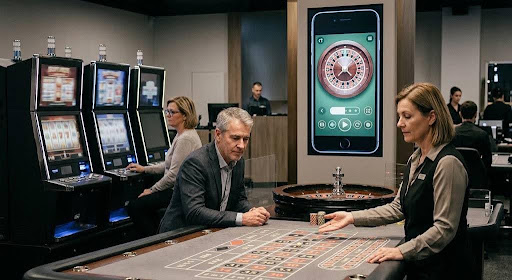
Looking at Europe as a whole reveals a few interesting patterns. Slots win on every volume metric in every market investigated so far, including Denmark, the UK, Spain, and Romania. This is a fact that is not up for debate. But what makes a game popular is a more complicated question that can’t be answered with a single number.
In the Spanish market, Roulette generates disproportionately high turnover relative to GGR and is one of the faster-growing categories, while placing higher in preference surveys than expected relative to its revenue. Blackjack, on the other hand, has a low GGR-to-turnover ratio and a high preference score among players who are more strategy-oriented. Live tables as a whole have an average stake that is 65 times higher than slots, so a small change in live table session volume can result in a large change in overall revenue, even though the session count may not indicate that.
When reviewing European casino market data, it is clear that no one metric settles the question. GGR share reflects where operator revenue is concentrated. Session count reflects where player time is concentrated. Turnover reflects where player money is at risk. Player preference surveys reflect what players choose if they are free to make their own decisions, rather than having their choices shaped by habit and accessibility. Each metric reflects a different player population making different choices for different reasons. The most popular game in Europe depends entirely on which player population you are asking about.