
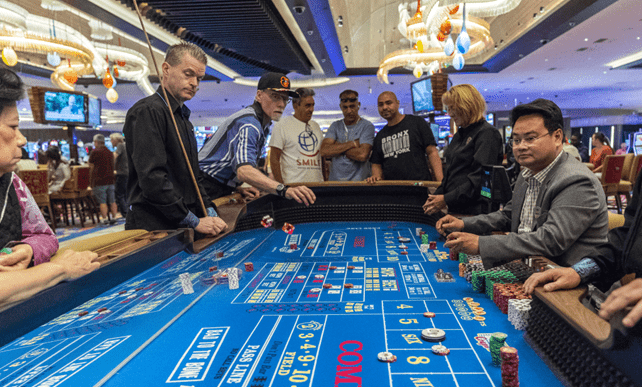
Anyone who has stood at a craps table and also spent a Sunday reading NFL lines knows the two feel nothing alike. One is loud, physical, and decided in seconds by two tumbling dice. The other is slow, analytical, and settled hours later by events on a field. But underneath the noise they are asking the same question every bettor in the United States eventually has to answer: what does this wager actually cost me, and can I read that cost before I put money down? Craps and sports betting answer that question in completely different ways, and understanding the difference is the single most useful skill a recreational player can build.
How the house edge actually works in craps
Craps is refreshingly transparent, because the math is fixed and published. Bet the pass line and the house holds an edge of 1.41 percent. Bet don’t pass and it drops slightly to 1.36 percent. These numbers never move. They are baked into the geometry of two six-sided dice, which is fitting for a game whose lineage runs back through a medieval English game called Hazard to the dice of Rome and the ancient Mediterranean. People have been calculating these exact probabilities, in one form or another, for a very long time.
The most striking number in the game is the one most beginners never take. The odds bet, placed behind a pass line wager after a point is set, carries a house edge of zero percent. It is the only genuinely fair bet in the building, and its existence is a big part of why serious students of gambling treat craps as a teaching game. Institutions like the UNLV research collection devoted to the history and mathematics of gaming exist precisely because these games reward study, and craps is where a lot of that study starts. The lesson is simple: in craps you can know your exact disadvantage before the dice leave the shooter’s hand.
Why sports betting odds are a different animal
Sports betting refuses to hand you that certainty. There is no fixed house edge on a point spread, because the true probability of a team covering is unknown to everyone, including the book. What the sportsbook charges instead is the vig, and on a standard two-sided market priced at -110 on both sides, that built-in commission works out to roughly a 4.5 percent hold for the house. Put plainly, a bettor has to win about 52.4 percent of their -110 wagers just to break even, before anyone has won or lost a single actual dollar of value.
That is the whole game right there. In craps the disadvantage is a constant you accept. In sports betting the disadvantage is a moving target you try to beat by being better than the market at estimating what will happen. One is a test of discipline; the other is a test of judgment. Neither is a shortcut to anything, and treating either as a way to solve a financial problem is the fastest route to trouble. Both are entertainment first, and the players who last are the ones who never forget it.
Where the two games meet for US players
The legal maps for the two activities look different too. Real-money online craps is currently available in only a handful of states that have licensed online casino play, among them Michigan, Pennsylvania, New Jersey, West Virginia, Connecticut, Delaware, and Rhode Island. Sports betting, by contrast, has spread to dozens of states since 2018. That gap is why so many dice fans across the rest of the country play the social and sweepstakes versions instead, and why only about half of the major sweepstakes sites bother to carry a proper craps table at all. For players sorting through those options, a roundup of the best craps sites in the USA is a practical way to see which platforms offer a real table rather than a dice-themed slot dressed up to look like one.
The comparison matters because the two games train opposite instincts. Craps teaches you to respect a fixed edge and manage it. Sports betting teaches you to hunt for an edge that may not be there. A bettor who understands both tends to make calmer decisions in each, because they have internalized what the price of a wager really is.
Reading value instead of chasing it
The bettors who enjoy this the longest are the ones who read odds the way a careful shopper reads a price tag, not the way a gambler reads a fortune cookie. That habit is the connective tissue between the craps pit and the sportsbook, and it is the same instinct that rewards players who understand why the range of games on offer matters for a betting audience in the first place. Variety is only valuable if you can tell which options are priced fairly and which are not.
So the honest answer to craps versus sports betting is that they are not rivals. They are two different exams on the same subject. One gives you the answer key up front and asks whether you have the discipline to use it. The other hides the answers and asks whether you can out-read the room. Learn to sit both, and the odds stop being intimidating and start being information, which is exactly what they were meant to be all along.