
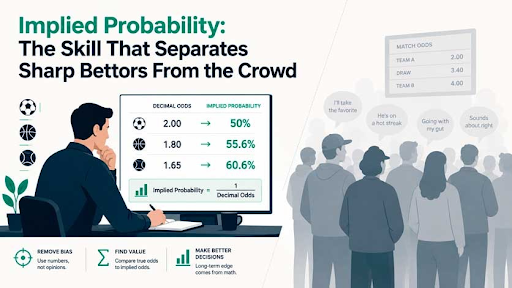
Ask any successful handicapper what separates a winning approach from a losing one, and the answer is rarely about picking winners. It’s about finding value. And you cannot find value without understanding implied probability — the single most important concept for anyone who takes betting seriously.
Every set of odds you see, whether it’s a moneyline, a point spread, or a soccer 1X2 market, is really just a probability dressed up in numbers. Learning to read that probability is the difference between betting on gut feeling and betting with an edge.
What implied probability actually means
Implied probability is the conversion of betting odds into a percentage chance of an outcome. When a bookmaker offers a team at even money, they’re telling you the market believes that outcome has roughly a 50 percent chance of happening. The math is straightforward once you know the formula.
For American odds, a favorite at -150 implies a probability of 150 divided by 250, or 60 percent. An underdog at +200 implies 100 divided by 300, or about 33 percent. As financial education resources like Investopedia explain, the same logic that governs implied probability in betting markets also underpins how professionals price risk in financial markets — it’s the language of probability applied to money.
The key insight is this: odds are not neutral. They reflect what the market — and the bookmaker — believes will happen. Your job as a bettor is to form your own probability estimate and compare it against the implied probability baked into the odds. When your estimate is higher than the implied probability, you’ve found value. When it’s lower, you should pass.
The bookmaker’s margin: the hidden tax on every bet
Here’s what most casual bettors never account for: the implied probabilities of all outcomes in a market always add up to more than 100 percent. That extra slice — usually between 3 and 10 percent depending on the sport and market — is the bookmaker’s margin, sometimes called the vig or juice. It’s how the house guarantees a long-term profit regardless of individual results.
Consider a two-way market where both sides are offered at -110. Each side implies roughly 52.4 percent, adding up to about 104.8 percent. That extra 4.8 percent is the margin. To bet profitably over time, you need to overcome this built-in disadvantage, which means you can’t just pick winners — you need to pick winners at prices that offer genuine value after stripping out the margin. This is where tools that calculate fair probability become essential. A resource like ImpliedScore takes the odds you enter and converts them into market-implied probabilities for exact scorelines, both teams to score, and totals, while also showing the fair odds with the margin removed — giving you a clear picture of what the market truly believes versus what you’re being charged. Seeing the fair probability alongside the offered price makes it far easier to judge whether a bet is worth taking.
From probability to expected value
Once you can read implied probability and strip out the margin, the next step is expected value, or EV. Expected value is the average result you’d expect if you made the same bet many times over. A positive-EV bet pays off in the long run; a negative-EV bet slowly drains your bankroll, even if it occasionally wins.
The calculation is simple in principle. If you believe an outcome has a 55 percent chance of happening but the implied probability from the odds is only 50 percent, you have a 5 percent edge — and that edge, applied consistently across many bets, is what builds a bankroll. The challenge, of course, is accurately estimating the true probability. This is where statistical models earn their keep. Modern sports forecasting relies heavily on probabilistic models, and outlets like FiveThirtyEight have popularized the use of Poisson-based and Elo-based systems to forecast outcomes across football, soccer, basketball, and baseball. These same statistical foundations power the tools serious bettors use to estimate fair probabilities.
Why exact-score probability matters in soccer
In soccer especially, implied probability goes deeper than just the match result. Markets like correct score, both teams to score, and over/under totals all carry their own implied probabilities, and they’re often where the sharpest value hides. The Poisson distribution — a statistical model that estimates the likelihood of a given number of events — is the industry standard for modeling soccer scorelines, and refinements like the Dixon-Coles adjustment improve accuracy for low-scoring matches.
For a handicapper, understanding these models turns a vague sense of “this game feels like a 2-1” into a concrete probability you can compare against the market. If the implied probability of a specific scoreline is meaningfully lower than your model suggests, that’s a value opportunity. If it’s higher, you’ve been warned off a trap. The bettors who consistently profit are the ones who do this comparison systematically rather than emotionally.
Putting it into practice
Reading implied probability isn’t just theory — it’s a habit that reshapes how you approach every bet. Before you place a wager, convert the odds to a percentage. Strip out the margin to find the fair probability. Compare that fair probability against your own estimate. Only bet when your estimate gives you a genuine edge. This discipline won’t make you win every bet — nothing will — but it will ensure that the bets you do make are grounded in math rather than hope.
The best handicappers aren’t fortune tellers. They’re probability readers who understand that beating the market means finding the gap between what the odds imply and what the data actually says. Master implied probability, respect the margin, and bet only when the value is real — and you’ll already be ahead of the vast majority of people placing bets on any given day.