
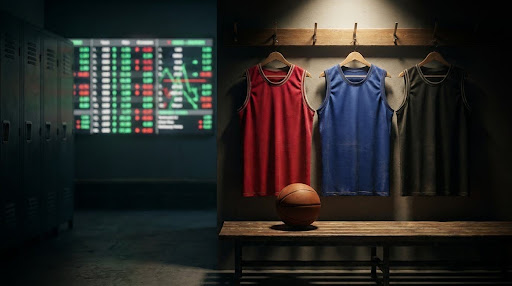
Every bettor is looking for an edge the sportsbook missed. Sooner or later, someone in a betting forum claims to have found one in the uniforms: a team that “never loses” in its black alternates, a fighter who wins more often in red, a cursed throwback jersey.
It’s a fun theory, and it isn’t completely crazy. Researchers have studied uniforms and winning for almost 40 years, and a few of their findings were real. But if you want the honest answer before you read any further, here it is: for almost every bet you will ever place, the uniform tells you nothing the odds don’t already know.
This article walks through what the research actually found, the rare cases where gear truly changed results, and why the factors that really move a line have nothing to do with jersey color.
Does uniform color change who wins?
The most famous study on this topic came out in 2005. Researchers at Durham University looked at boxing, taekwondo, Greco-Roman wrestling and freestyle wrestling at the 2004 Athens Olympics, where athletes are assigned red or blue gear essentially at random. Red won more than half the bouts in all four sports (about 55% overall), and the advantage showed up mainly in closely matched bouts.
A few years later, researchers at Germany’s University of Münster found a likely reason. They showed 42 experienced taekwondo referees the same sparring clips twice, once as filmed and once with the colors digitally swapped. Athletes who appeared in red scored about 13% more points on average, even though the fighting was identical. In other words, the “red advantage” seemed to live in the referees’ eyes, not in the athletes’ muscles.
Here is the part most betting forums leave out. In a study published at the end of 2024, the original Durham researchers teamed up with colleagues from VU Amsterdam and Northumbria University to check whether the effect still holds. Looking at 6,589 bouts from 16 tournaments between 1996 and 2021, they found red won just 50.5% of the time, which is not a statistically meaningful difference. Before 2005, red had won about 56% of close contests. The researchers think electronic scoring, rule changes and wider awareness of the effect have left referees less room for color bias.
Black uniforms have a similar story. A 1988 study by psychologists Mark Frank and Thomas Gilovich found that NFL and NHL teams wearing black picked up more penalty yards and penalty minutes from the 1970s to the mid-1980s. When the Pittsburgh Penguins switched to black mid-season in 1979–80, their penalty minutes rose from roughly 8 to 12 per game. It’s a fascinating result, but it is decades old, rests mainly on league penalty data from before modern video review, and later hockey studies have been split on whether it still holds.
What about the red corner in the UFC?
UFC fighters in the red corner win more than half their fights, but that’s not about the color. The UFC doesn’t publish a formal rule, but champions fight out of the red corner, and red usually goes to the higher-ranked fighter or the betting favorite. One analysis of 4,791 UFC fights found the red-corner fighter was the betting favorite about 70% of the time. A peer-reviewed study of UFC bouts found no link between trunk color and winning, so the simplest explanation is that the better fighter is usually placed in red. The sportsbook already knows who the better fighter is, so there is no edge in backing the red corner blindly.
When gear really did change results
There is one modern case where equipment clearly changed outcomes: swimming’s “super suits.” Speedo’s LZR Racer launched in February 2008. At that summer’s Beijing Olympics, swimmers wearing it broke 23 of the 25 world records set at the Games and, according to Speedo, won 98% of all swimming medals. The effect was so obvious that swimming’s governing body, FINA (now World Aquatics), banned polyurethane and full-body suits from January 1, 2010.
Notice what happened there. The advantage was huge, everyone could see it, and it was banned within two years. That’s the pattern with genuine equipment edges: they are public, priced into the odds almost immediately, and regulated away.
The opposite can happen too. At the 2014 Sochi Winter Olympics, the U.S. long-track speedskating team raced in a new high-tech suit called the Mach 39 and got off to a terrible start. Some skaters questioned the suit, and after Olympic officials cleared the change, the team switched back to its older Under Armour suits in the middle of the Games. The results didn’t improve: the long-track team left Sochi without a medal, and a later internal review pointed to other problems rather than the suit.
For bettors, the lesson is simple. When a team or athlete blames the gear, be careful about treating a change of gear as a reason to expect a turnaround.
Throwbacks, alternate jerseys and “uniform curses”
Every season, someone points out that a team is unbeaten in its throwback jerseys or can’t win in its alternates. These stats get shared a lot, but there’s no solid evidence they hold up once you look at full records rather than memorable games.
There are three problems with them:
- Tiny samples. A team might wear an alternate uniform four or five times a season. A 4–1 record in five games tells you almost nothing about the next game.
- Hidden factors. Teams often choose alternates for specific games, such as home rivalry nights or prime-time matchups. The opponent, the venue and the occasion are doing the work, not the shirt.
- Selective memory. Nobody posts about the alternate jersey with an ordinary 6–6 record. We remember the streaks that sound like a story and forget the rest.
If an “alternate-jersey record” is the main reason you like a bet, treat it as a trend to ignore and pass on the bet.
Home advantage: the home-and-away factor that actually matters
In most leagues, the home side wears or picks its primary uniform (in the NFL, the home team chooses its jersey color), so “home uniform” and “home team” are almost the same thing. If you look only at results by uniform, you’ll find that teams win more often in their home colors. That isn’t the jersey. It’s home advantage, one of the best-documented effects in sports.
The pandemic gave researchers a rare natural experiment. A University of Leeds and Northumbria University study of 4,844 matches in 11 European soccer countries compared games with fans to games played in empty stadiums. With crowds, home teams earned about 0.39 more points per game than away teams. Without crowds, that edge fell to about 0.22, almost half. Referees’ tendency to give away teams more fouls and yellow cards also shrank when there was no home crowd to pressure them.
So home advantage is real, and part of it comes from referees. But bookmakers have priced home advantage for decades. You’ll only find value when the market misjudges it in a specific situation, such as a long road trip, a neutral venue that is “home” in name only, or a crowd that is much smaller or bigger than usual. The color of the shirt adds nothing on top of that.
Where uniforms really matter: fit and comfort
To be fair to uniforms, they do matter to the people wearing them, just not in a way you can bet on. A jersey that’s too tight across the shoulders, shorts that ride up or heavy fabric that soaks up sweat are real distractions, and a wrestling singlet that doesn’t fit properly can shift during a match. Anyone who has ordered team uniforms, for example from Hamco Sports’ basketball uniform range, will tell you the real conversations are about sizing, fabric weight and breathability, not which color wins more games.
At the professional level, though, every team’s kit is designed, tested and fitted by major manufacturers, so the gap between two pro teams’ uniforms is tiny and the same every week. For a bettor, it’s a constant, not a variable.
What to focus on instead
If you want an edge, spend your time on the things that actually move a line:
- Injuries and lineups. A missing starter, a goalie change or a late scratch matters far more than any jersey.
- Rest, travel and schedule. Back-to-back games, long road trips and short weeks show up in performance.
- Matchups and styles. In combat sports, look at reach, styles and weight cuts. In team sports, look at how one team’s strengths line up against the other’s weaknesses.
- Line movement. Track where the odds open and where they close. Consistently getting a better number than the closing line is one of the clearest signs that your process works, though it’s a signal rather than a guarantee and needs a large sample.
- Bankroll discipline. Fixed stake sizes and no chasing losses will do more for your results than any trend you find.
For daily breakdowns that weigh these factors game by game, check out our free sports picks.
The bottom line
The research on uniforms is genuinely interesting. Red once gave combat-sport athletes a small edge, probably through referee bias, black uniforms were linked to more penalties in the 1970s and ’80s, and one generation of swimsuits rewrote the record books. But the color effect has faded as judging improved, the big equipment edges were obvious and quickly banned, and most uniform “streaks” are noise.
Treat uniform theories as a great bar debate, not a betting system. Put your time into injuries, matchups, prices and discipline, because that’s where real edges come from.
Please bet responsibly and only with money you can afford to lose. You must be of legal betting age where you live. If gambling stops being fun, free and confidential help is available 24/7 from the National Problem Gambling Helpline at 1-800-MY-RESET (1-800-697-3738) or ncpgambling.org.