


Poker has remained one of the most fascinating card games for decades, seamlessly blending luck, psychology, and strategy. Millions of people around the world play it both live and online. Today, classic poker almost always refers to Texas Hold’em — the variant people usually mean when they simply say poker. In this article, we’ll break down the rules for beginners in a clear and detailed way — from hand rankings to betting procedures. And if you want to start practicing in comfortable conditions right away, many players choose Official BC.Poker.
Here’s what we’ll cover:
- Main poker hand rankings
- Betting rounds and order of play
- Essential terms
- Variations of classic poker
- Tips for beginners
What is BC.Poker
BC Poker is a modern online poker room powered by the well-known crypto platform BC.Game. It has quickly gained popularity thanks to its soft player pool, user-friendly interface, and attractive conditions for both newcomers and experienced players.
At BC Poker, you’ll find classic Texas Hold’em in cash games and tournaments. The platform supports cryptocurrency deposits and withdrawals, offers fast transactions, and features a generous loyalty program with up to 50% rakeback. Beginners feel especially comfortable here: there are play-money tables, low-stakes games, and an intuitive, straightforward software.
What is Classic Poker
Classic poker (Texas Hold’em) originated in the mid-20th century in Texas and rapidly became a worldwide classic. The game is played with a standard 52-card deck. Between 2 and 10 players can sit at the table at the same time.
Each player receives two private cards (hole cards), while five community cards are dealt face-up on the table. The best five-card hand is formed using any combination of your own cards and the community cards. This mechanic makes Hold’em incredibly dynamic and strategically deep.
Unlike older formats such as Five-Card Draw or Seven-Card Stud, classic poker places much greater emphasis on community cards and table position.
Poker Hand Rankings
In poker, the best five-card combination always wins. There are ten possible hand rankings, and the order is quite easy to remember — from weakest to strongest:
- High Card — no combinations; the highest card wins.
- One Pair — two cards of the same rank.
- Two Pair — two different pairs.
- Three of a Kind (set or trips) — three cards of the same rank.
- Straight — five consecutive cards (ace can be high or low).
- Flush — five cards of the same suit.
- Full House — three of a kind plus a pair.
- Four of a Kind — four cards of the same rank.
- Straight Flush — a straight of the same suit.
- Royal Flush — 10-J-Q-K-A of the same suit. The rarest and strongest hand possible.
Hand Rankings Table
Understanding these rankings is essential because the winner of each hand is always determined by the highest-ranking five-card combination. If two or more players have the same hand type, the pot is awarded to the one with the strongest kickers (side cards). Remember that suits have equal value in poker — there is no trump suit like in some other card games. Mastering this table will help you quickly evaluate your hand strength during real play.
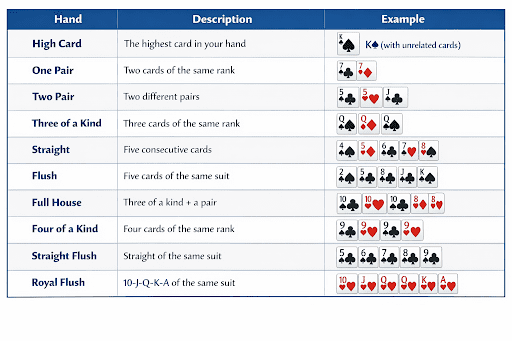
When hands are equal, kickers (the highest remaining cards) are compared. All suits are equal in strength.
Basic Rules of the Game
A full hand of Texas Hold’em is structured around four distinct betting rounds, each offering new information and strategic decisions. The game begins with players receiving their private cards and progresses as community cards are gradually revealed on the board. This step-by-step format is what gives classic poker its perfect balance of excitement and depth.
After each hand, a betting round takes place. Players have several options:
- Fold – to leave the hand, forfeiting any chips already in the pot.
- Check – to pass your turn without betting, provided no one has placed a bet yet.
- Bet/Raise – to place a new wager or increase an existing one.
- Call – to match the current bet made by another player.
- All-in – to commit all of your remaining chips to the pot.
Blinds – are mandatory bets, consisting of the small blind and big blind, which establish the initial pot. In some games, an ante is also added, requiring all players to contribute a small amount.
Going all-in allows a player to continue in the hand even if they do not have enough chips to fully match a bet. This may result in the creation of a main pot and one or more side pots for additional wagers.
Tips for Beginners
Learning poker is best done gradually, starting with the fundamentals. Don’t try to memorize every possible situation at once. Focus on understanding the core principles and practicing regularly.
Here are some key recommendations that will help you avoid the most common beginner mistakes:
- Don’t play every hand — discipline is more important than excitement.
- Consider your position at the table: a late position gives you a significant advantage.
- Pay attention to board texture: coordinated cards of the same suit or consecutive ranks signal danger.
- Start at low stakes and never risk your entire bankroll.
- Avoid tilt — emotional decisions are expensive.

Where to Play Safely
Today, classic poker is more accessible than ever online. It’s important to choose trusted platforms with strong security and transparent banking.
A great option for beginners is BC.Poker. Its soft player field, fast cryptocurrency payouts, up to 50% rakeback, and convenient mobile version make it comfortable for both newcomers and regular players.
Classic Poker
The rules of classic poker are relatively simple, yet behind this simplicity lies vast room for strategy and self-improvement. Start by mastering hand rankings and betting procedures, practice consistently, and gradually raise your level.
The most important thing is to enjoy the game and approach it responsibly. Good luck at the tables — may the royal flushes be with you!