

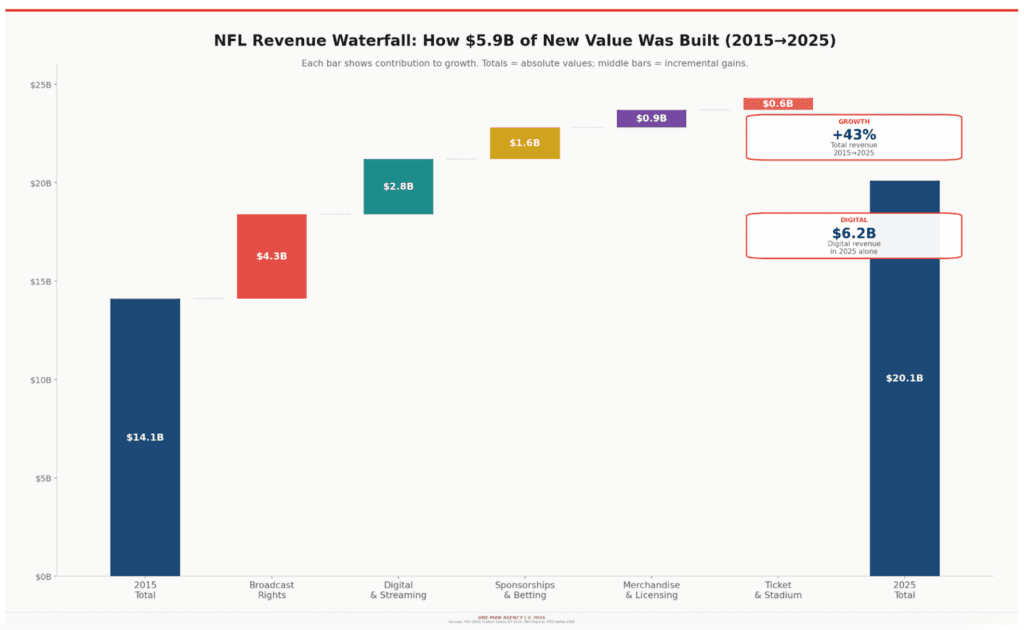
The NFL made $20.1 billion in 2024. It’s more than Iceland’s GDP. But that’s not the point. The point is how that money came about now compared to ten years ago.
Ten years ago, there were deals for broadcasts, tickets, and merchandise. That was it. Today, about 31% of league revenue comes from digital channels, such as streaming, betting partnerships, app data, and interactive content. The league didn’t just happen to get this. They built it on purpose, and everyone else in entertainment was watching.
The NFL’s Digital Pivot
For most of its history, the NFL was just a TV show. On Sunday, I like to relax on the couch and watch TV. I usually watch CBS or NBC. Nobody questioned it because it worked fine.
The league changed the model because they realized that if they give fans a limited amount of content, they will watch on time. But if you give them content they actually want every day — like film breakdowns, mic’d-up footage, training camp stuff, and real-time stats — they don’t leave. They stay.
So they built NFL+. In 2016, it partnered with Twitter to provide live clips of Thursday Night Football. Between 2020 and 2024, they will invest $300 million in app infrastructure. The official NFL app now has different camera angles, Next Gen Stats from chips in shoulder pads that update every 100 milliseconds, and live fantasy scoring.
A 2024 Nielsen study: Almost 70% of people who watch NFL games also use a second device during the games. Every game, not just sometimes. They’re checking live stats, updating fantasy lineups, placing bets, and texting friends. The NFL stopped fighting that and started building around it instead.
Streaming Rights: Who Pays What
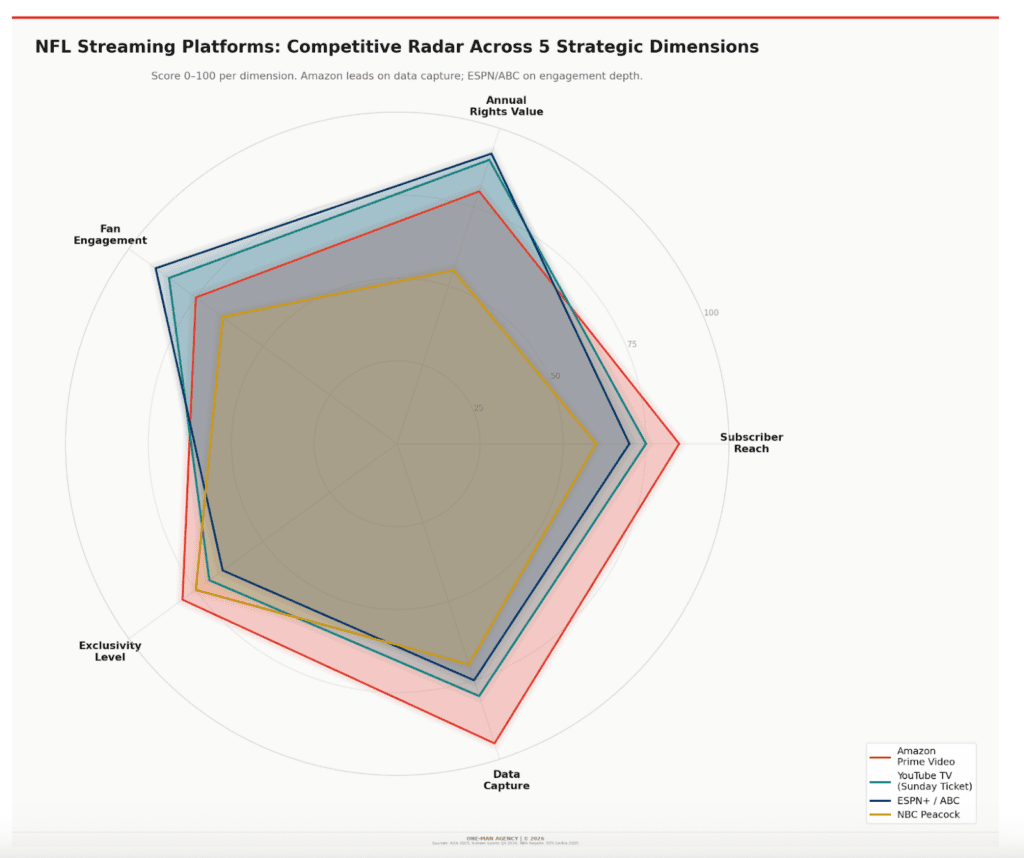
The TV landscape in 2026 is completely different from the one in 2015. Amazon Prime Video has exclusive rights to Thursday Night Football, and they’re paying $1 billion for it through 2033. YouTube TV paid $2 billion a year for Sunday Ticket. In 2024, Netflix will broadcast Christmas Day games.
| Platform | NFL Package | Annual Value |
| Amazon Prime Video | Thursday Night Football | ~$1B |
| YouTube TV | NFL Sunday Ticket | ~$2B |
| ESPN+ / ABC | Monday Night Football | ~$2.7B |
| Netflix | Select games | ~$150M/game |
| NBC Peacock | Exclusive playoff games | ~$110M/game |
The difference from old TV deals isn’t just the medium. When Amazon broadcasts a game, they know exactly how long you watched, what players you searched, whether you clicked through to a betting site, and what you bought before kickoff. Traditional TV didn’t have any of that information. The data is now worth more than the rights to it.
Sports Betting Changed Everything
The 2018 Supreme Court decision eliminated PASPA and allowed legal betting in 38 states. The NFL became the main reason for that market’s growth, happening almost immediately.
The amount of money bet on Super Bowl LVIII was estimated to be around $35.4 billion. The total amount of money spent on legal issues related to the 2024 NFL season was over $47 billion. DraftKings, FanDuel, and Caesars each pay around $120 million a year to be official partners of the NFL. This includes the rights to use the NFL’s logo on their websites, access to NFL data, and inclusion of live odds in broadcasts.
Ten years ago, the league acted like betting wasn’t a thing. Now they show live lines on screen during games.
This changed entertainment in a big way. It showed that people really want to be involved even when they’re just watching. Not just watching — tracking a position, following money, making decisions live. Streaming platforms, gaming companies, and online casinos all used that model. Play at Wincraft and you will see that it run on exactly this logic — real-time, engaged, always something happening.
What Other Industries Took From the NFL
The NFL didn’t invent any of this. But they ran it at a scale that no one else had — 100 million viewers, 17 weeks a year, for decades. That’s a good place to practice.
Streaming platforms followed the same model of offering both appointment-based shows and daily content. Now, Netflix and HBO both invest in live events to create shows that people can’t miss. Sunday football is the reason. It has always been like that.
Online gaming used the second-screen overlay feature. NFL fans were doing things like checking live odds, interacting with content, and making decisions during a broadcast all on their phones long before gaming platforms offered these features.
Esports followed the franchise model. City-based teams, a season structure, and long-term fan loyalty are all things that major esports leagues were learning from when they tried to build sustainable audiences around 2018.
Fantasy football: There are 62 million players in America, and they spend an average of $653 per year. The same mechanics that make online gaming so popular—unpredictable rewards, ongoing progress, social competition, and a mix of skill and chance—are also what make it so fun. Fantasy proved they work on a large scale. The gaming industry noticed this and took action.
The Numbers
- NFL games took 93 of the 100 most-watched broadcasts in the U.S. in 2024
- Digital revenue grew from $800M in 2015 to $6.2B in 2025
- Average NFL game generates 1.2 billion social media interactions
- Teams with strong digital content saw 37% higher season ticket renewal rates
This last one is the most important for any entertainment business. Investing in content doesn’t just increase traffic to your website in the short term. It changes how much it costs to retain customers. Consumers of daily content cost more to acquire but are much cheaper to keep year after year.
One fan. Amazon has the game. DraftKings for fantasy. A betting app for live props. Visit the team store to purchase a jersey. Team up with YouTube to create weekly content. There are five ways to make money, and one way to build relationships. That’s what the NFL built. By 2026, every entertainment platform will offer some version of it.
“The NFL is no longer a football league that happens to do digital. It’s a digital entertainment company that happens to play football.” — Sports Business Journal, 2025
FAQ
Does the NFL make money from betting directly?
Not from the handle. Official partnerships pay about $120 million each year for partner status. This includes data licensing and promotions shown on the screen during the broadcast.
How did the NFL influence gaming platforms?
Live wagering during content, along with established second-screen patterns that UX teams emulate, showed that audiences pay for multiple entertainment products that overlap.
What is Next Gen Stats?
The chips in the shoulder pads are tracked and updated every 100 milliseconds. The app shows how fast each player is going, how fast they’re accelerating, and where they are on the field. It has the most detailed real-time sports data available to the public.