
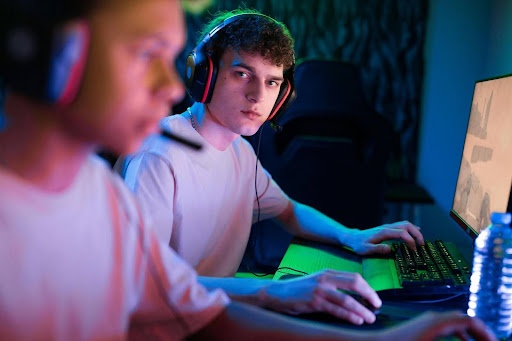
Sports in the online world now go from great games to fast action where people can play against each other. This happens because there is real-time data that moves very quickly, strong cloud servers for games, and the best ways to keep all games in sync. As the lines between fields and online play start to fade, new computers help make a place where people everywhere can play to win and feel sure the games are fair.
Today, people want games to be quick, feel smooth, and be safe for everyone, no matter where they play. To have this, you need a strong PC gaming platform. It should handle tough game movements and show clear pictures without any lag or issues.
Sub-Millisecond Input and Tick Engine Architecture
Sports that people play online need everything to match up at all times. In the past, games on the internet used servers that would refresh 30 to 60 times each second. This would make a delay of 16 to 33 milliseconds on the server. Now, we use new systems that have servers working with no extra software on top. These servers run at 128 times per second or even more.
Tick Rate Latency Window Comparison:
30 Hz: |==============================| 33.3ms per frame
60 Hz: |===============| 16.6ms per frame
128 Hz: |=======| 7.8ms per frame
This fast refresh cycle updates the game state every 7.8 milliseconds. It is best suited for the type of hardware that has high processing speeds on the client side.
High-Polling Input Capture: These peripherals operate at 8,000Hz and send input after every 0.125 milliseconds.
Direct Response from System: The system scheduler handles hardware interrupts right away. This lets you skip any wait in the display line.
Between-Tick Processing: Server engines handle actions between server ticks. This can stop small screen stutters when there is fast movement.
As you can see from tests by Cloudflare Infrastructure Engineering, making fewer changes when data moves between places helps keep things fair for everyone in matchmaking pools around the world.
Decentralized Edge Compute and Cloud Rendering
To help stop lag and so teams do not need to get costly gear, today’s online sports leagues place game servers near the homes of players in large cities. Game details do not go far away to big data spots. The latest internet setups keep these servers only about 10 to 15 kilometers from the player.
| Architectural Component | Legacy Infrastructure | Next-Era Edge Infrastructure | Performance Impact |
| Server Proximity | Centralized Regional Nodes | Decentralized Metro Edge | 70% reduction in round-trip time |
| Packet Routing | Standard Public IP Paths | Dedicated Anycast Fiber Networks | Eliminates jitter and packet loss |
| Physics Rendering | Client Hardware Dependent | Cloud-Assisted Hardware Sharding | Ensures uniform frame delivery |
By sending the hard work of wind, tire grip, and crash math to special edge nodes, players get smooth frames. They do not see screen tearing.
Security Models in High-Stakes Arenas
As prize pools grow, anti-cheat security gets better. It does more than just watch the app. Now, it looks deep inside the computer system. It uses smart computer learning to find cheats. Today, game servers lead the way. When you play, your computer sends the raw key or mouse moves. It does not send the full game state or guesses.
This new way of handling things makes sure your device does not get unsafe memory. If there is a problem, the main server will say no to updates that do not fit. Also, the anti-cheat system on the server uses machine-learning tools to look at where people move and aim. It can spot small aim moves and times that are too quick for people to do by themselves.
Scaling Global Arenas for Competitive Multiplayer Games
It takes smart load balancing and strong internet backbones to connect millions of people who are playing at the same time. The systems use server sharding that can always change and adjust. This way, they make new regional instances fast as more players join in. To run non-stop matchmaking and keep pings low, you need special hardware. It can host fast-paced competitive multiplayer games where people want to win.
Real-Time Analytics and Spectator Virtualization
The last part of today’s online sports setup is real-time telemetry extraction. Servers send raw game data right to viewer clients instead of sharing packed video streams. As a result, viewers can get new camera angles in 3D and quick data for analysts. This setup does not slow down the main competition server.
Real Questions Answered
What is the minimum internet connection speed required for virtual sports?
A steady connection and low ping are more important than just high speed. A good fiber line with 25 Mbps for download and 10 Mbps for upload, and less than 15ms delay, will feel better to use. This will feel much better than a fast 1 Gbps line that goes up and down a lot.
How do 128 Hz server tick rates improve competitive gameplay?
A 128 Hz tick rate means the server changes the game 128 times in one second. This happens once every 7.8 milliseconds. A server like this lowers input delay to half what you get with a 64 Hz server. Because of this, your quick moves get noticed right when you do them.
Can cloud gaming match native PC performance in virtual sports?
Cloud platforms can now get motion-to-photon delay down to less than 20ms. They use edge nodes that are quick and have high-rate stream encoding for this. A native PC at the top is still thought of as the best way to play for top people. But cloud platforms are now good enough for people who want the best.
Why is kernel-level anti-cheat necessary for virtual sports?
Modern cheats go straight into the core of the system. Most programs can’t see them because of that. Kernel-level tools work where the system’s core is. They help find things that should not be there. They also help make sure that play is fair for everyone.
The Future of High-Performance Virtual Competition
Today, the way PCs work has changed the world of sports online. Now, playing sports on a computer can feel real. It is much like normal sports. With better internet, things move fast with data. There are strong computers and good safety at the heart of the computer. People get quick actions when they play. This lets them play at the top level. As edge computing gets bigger and real-time art for these games gets better, these online games will keep growing. Games will also feel more like real life for people all over the world.